

Deepen your understanding of how and why things work.
Led by internationally recognised researchers, you’ll study the laws of physics and explore how these principles are applied in our everyday lives – from understanding the nature of time to developing new technologies.
You'll combine your scientific and mathematical knowledge with skills in computer programming and statistics to understand theories relating to quantum mechanics, biophotonics, astronomy or astrophysics. Or you can apply your knowledge to develop advanced materials, electronic and optical devices.
Your high-level technical, analytical and problem-solving skills will lead you to a wide range of rewarding opportunities in sectors such as education, finance, engineering, computing and management.
Alternatively, continue to a higher degree by research to kickstart your career in research and uncover new scientific knowledge or develop new devices, products or processes.

Career possibilities
Our programs prepare you for your first job and beyond. Here are some of the careers you could be on your way to:
- Research analyst
- Data scientist
- Mathematician
- Cyber security analyst
- Data analyst
- Applied physics lecturer
- Quantitative analyst
- Bioinformatician
Average annual salary range
Data Scientist
seek.com.au
Average annual salary range
Mathematician
seek.com.au
Next steps after graduation
The Bachelor of Mathematics provides quantitative training that will set you apart in the job market and see you excel in mathematics or one of the many disciplines it influences.
With a degree in mathematics, you will be sought by industry for your excellent quantitative and problem-solving abilities, and gain a wide range of rewarding positions in the public and private sectors. This includes roles in:
- finance and quantitative finance
- economics
- mathematical research
- statistics
- actuarial studies
- meteorology
- information technology
- data science.

The problem-solving skills I developed during my mathematics degree have been so widely applicable to the range of projects I have worked on in my undergraduate research and in my role as a Data Analyst Consultant.
The problem-solving skills I developed during my mathematics degree have been so widely applicable to the range of projects I have worked on in my undergraduate research and in my role as a Data Analyst Consultant.
Events
See all events
12 November
Postgraduate business analytics information webinar

Stories
See all stories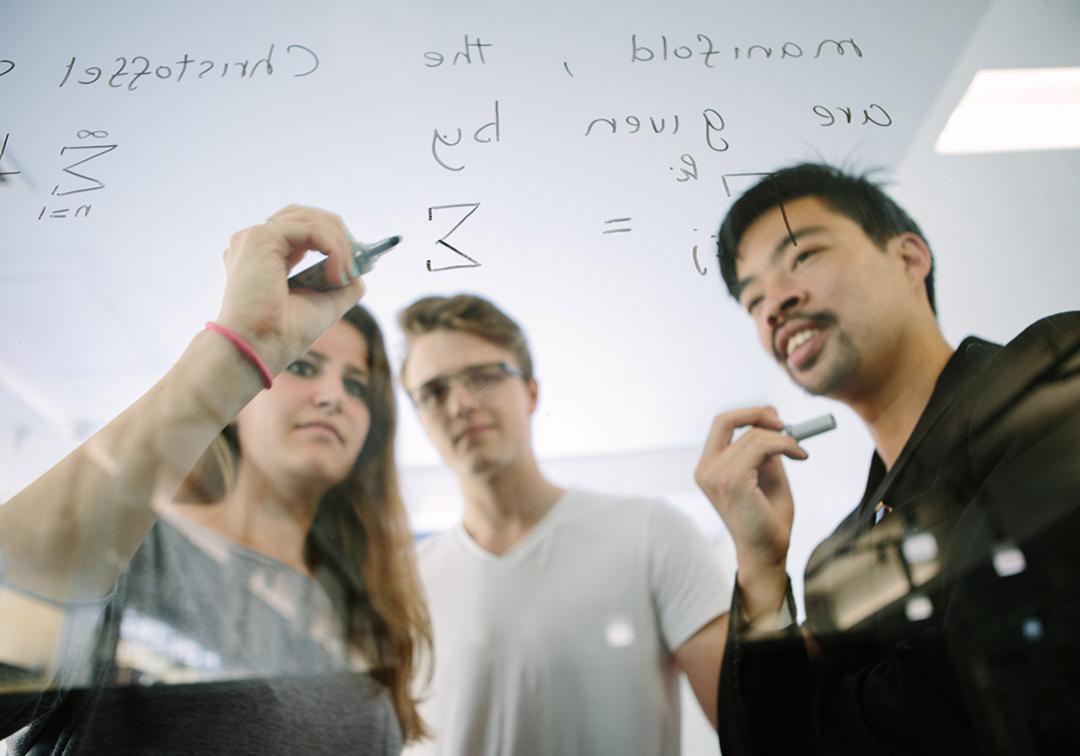

UQ people
Making the greatest mathematical discoveries
3-minute read

Study tips
UQ science scholarships to help fund your studies
8-minute read
Stories
See all storiesUQ people
Making the greatest mathematical discoveries
3-minute read
Study tips
UQ science scholarships to help fund your studies
8-minute read
How you'll learn
Your learning experiences are designed to best suit the learning outcomes of the courses you choose.
- Lectures
- Tutorials
- Work placements
- Overseas study
- Research experience
- Laboratory work
- Fieldwork
- Workshops
What you'll study
At UQ, subjects are called 'courses'. Here's a sample of the courses you could study:
- Electromagnetism & Modern Physics [Core course]
- Mechanics & Thermal Physics [Core course]
- Thermodynamics & Condensed Matter Physics [Elective]
- Quantum Mechanics [Elective]
- Space Science & Stellar Astrophysics [Elective]
- Dynamics & Relativity [Elective]
Helpful advice, right when you need it
Get useful info to help you navigate the confusing parts of getting into uni. Scholarship reminders, access to events and experiences, and advice from real students.
Sign up for updates. (No spam! We promise.)