Ruth Mirams’ career story is a shining example of the limitless opportunities available to those who pursue an education and career in science.
Her journey began as a budding political science and international relations student, before her passion for science eventually guided her toward completing a PhD in chemistry.
Ruth has specialised in roles within federal government departments, namely the Department of Industry, Innovation and Science, and the Department of Foreign Affairs and Trade, including in Timor-Leste. She has also worked in consultancy roles across Australia.
We can look at Ruth’s career in science as a snapshot of the many paths and opportunities available to those who study this field.
Ruth’s career now
Today, Ruth is a Social Impact Manager at Tennant Mines, based in Tennant Creek in the Northern Territory. In this role, she leads the design and delivery of community-based programs focused on workforce development, stakeholder engagement, and ESG performance.
Ruth works closely with Traditional Owner groups, Barkly Aboriginal communities, and local residents to create equitable employment pathwayslocal impact from mining projects in the Barkly. Her work spans strategic planning through to operational delivery, including social impact assessmentsplanning, compliance reportingland access negotiations and stakeholder engagement. , and ESG monitoring aligned with national and international sustainability frameworks.
Her analytical skills and ability to ask the right questions, both sharpened during her time at UQ, continue to underpin her work as she brings together internal teams, contractors, and community partners to ensure programs are culturally respectful, commercially viable, locally relevant, and sustainably impactful.
How she got there
Let’s go back to the beginning, where, as a Brisbanite coming out of high school, Ruth was looking toward her future ambitions. Her next step was to enrol in university, and with UQ’s reputation for world-class programs and facilities, and its proximity to home, her choice was simple.
“My study career started in a Bachelor of Arts, which I loved, but I felt like I was neglecting my love for science, so I made the easy decision to complete a double degree, adding the Bachelor of Science,” Ruth says.
“I have always loved chemistry, so it was a natural choice as the science major.”
Ruth’s fondest memory of studying at UQ is her lecturers.
“They were fantastic, not only in terms of how they taught, but how they supported me to stay engaged with the content and get the best out of myself during a challenging personal time for me,” she says.
“I’ll never forget that genuine care they showed for students on a personal level.”
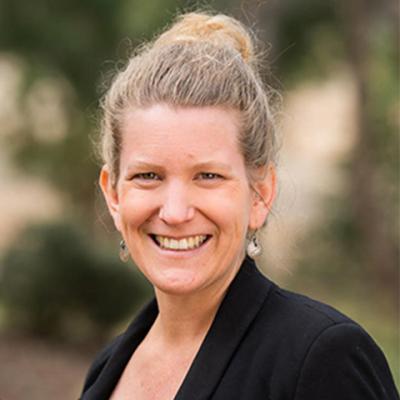
I'd encourage the next generation to find their own style and do it their way. For me, that has been making wide and enduring networks.
Ruth’s PhD
Ruth’s passion for science and enjoyment of research-based subjects in her undergraduate and honours years were some of the main motivators for her completion of a PhD.
Her PhD focused on nuclear magnetic resonance (NMR), a technique which uses magnetic resonance to identify chemical structure. Ruth used the flagship Queensland NMR Network (QNN) 900 MHz spectrometer at UQ throughout her PhD to identify the structure of proteins involved in cell death signalling.
“I had the privilege of a scholarship and thought I would be unlikely to be given an opportunity to pursue something I was interested in again,” Ruth says.
“It was excellent to be able to pursue that interest, but it wasn’t until I gained employment outside of that setting that I fully appreciated the value of having a PhD. The high-level analytical skills, data literacy, research ability, and writing I honed during my PhD have served me very well throughout my professional career.”
“The ability to synthesise new information and see a project through from start to finish is an incredibly valuable trait to have when it comes to project management, resilience, and personal drive.”
Wise words for other students
Ruth’s advice for future science professionals and students is simple – and it’s something she believes held her in good stead as she forged her own career.
“I’d encourage the next generation to find their own style and do it their way – for me, that has been making wide and enduring networks,” she says.
“Getting to know the people around you, their skills, and how you can improve yourself… this has been an invaluable formative building block of my career.”
Learn more about UQ's Bachelor of Science, or discover how to get a PhD.