We live in a data-driven world. Data science graduate programs can help you get ahead in your career.
Thanks to greater computing power and rapid technology advances, information is being generated faster than even before. And while this brings many benefits to society, it also comes with challenges.
For example, managing and analysing all the data at our fingertips is a complex job. There’s an urgent need for people who can understand raw data and translate it into meaningful insights. In fact, doing so is the key to:
- addressing global challenges
- making scientific breakthroughs
- discovering opportunities and ideas that can shape our world’s future.
This is why completing a postgraduate data science degree could lead you to a rich and rewarding career. So, if you’re looking to complete a graduate degree in data science, the question isn’t “will it be worth it?”. The question is “which specific degree should I do?”.
Choose your own data adventure

Whether you’re looking to change your career path or further sharpen your expertise, The University of Queensland offers a range of data science postgraduate courses via 4 key master’s programs. You can tailor your studies based on your interests, your career ambitions and the skills you wish to acquire.
Get to know our data programs below to discover how you can unlock the power and potential of big data. Your studies will prepare you to tackle some of the biggest issues facing public health, agriculture, conservation, urban planning, business and beyond.
Graduate degrees in data science at UQ
The data science degrees you can complete at UQ include:
Data science salary
Data science is one of the most financially rewarding fields you can enter in Australia. Salaries reflect strong and sustained demand across technology, government, finance, health and beyond, with employers across every sector searching for graduates who can turn complex data into real decisions.
Data scientists are currently earning between $115,000 and $135,000 per year on average, while data engineers typically earn between $125,000 and $145,000 (Seek.com.au). Entry into either field from a postgraduate qualification puts you well above the Australian median salary from the start of your career.
Master of Data Science
The abundance of data available today gives businesses and governments the opportunity to leverage insights from that data to get ahead of the curve. For example, financial data scientists are finding new ways to mitigate financial risk and make strategic investment decisions.
Tech giants, start-up companies, consulting firms and governments don’t have much in common, but they can all benefit from the clever use of data. Analysing and interpreting information can help any organisation:
- solve a variety of problems
- build meaningful relationships with people
- optimise marketing strategies
- develop and optimise services/products
- effectively plan for growth.
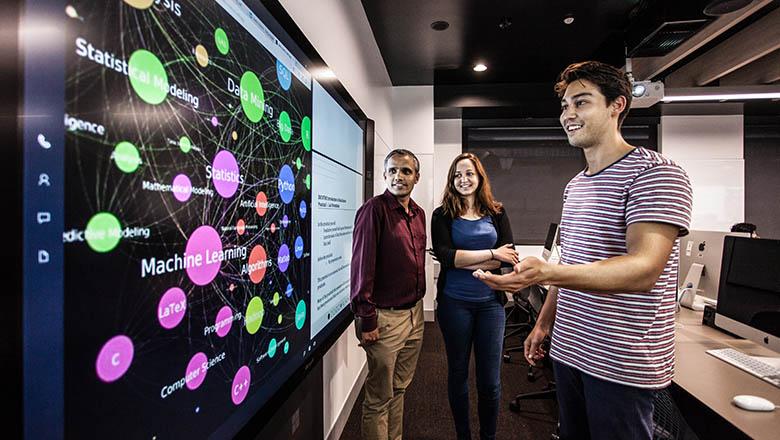
UQ's Master of Data Science is built to prepare you for work across almost any sector in Australia or abroad. You'll study advanced topics across computing, statistics and mathematics, and choose from electives in business, finance, health or science, giving you the depth to specialise and the range to adapt. By delving into a data-based career in the digital economy, you may even help revolutionise the way we work, live and communicate in the future by working in fields like artificial intelligence and cybersecurity.
This program prepares you to use big data tools, technologies and research to make informed decisions in data-intensive environments. You’ll study advanced topics including computing, statistics and mathematics and choose from a business, finance, health or science elective.
Consider studying the Master of Data Science if:
- you’d love an innovative job in a tech company or start-up
- you’re passionate about creating positive change in the community
- you want an inter-disciplinary education with direct industry contact and practical experience.
Master of Bioinformatics
Modern genome sequencing technologies allow us to rapidly test millions of biological samples. As this tech keeps getting more accurate and affordable, scientists can now discover solutions at a previously unimaginable pace. Problems that once took decades can now be solved in mere months.
The Master of Bioinformatics is your door to this exciting world, where you’ll get to:
- increase your technical and research skills in core bioinformatics areas
- update your knowledge around recent technologies and methodologies including advanced applications of computational statistics, software engineering and programming languages such as R
- immerse yourself in a practical research laboratory.

Upon graduating, you’ll have all the skills required to conduct a wide range of genome scale analyses with data produced by next-generation sequencing (NGS) technologies. Your theoretical and practical study is also supplemented by an independent research project.
Consider studying the Master of Bioinformatics if:
- you’re curious to discover how genetic data can help re-shape the way we manage our health and environment
- you have a bachelor’s degree or extensive professional experience in biological sciences, computing and mathematics
- you’d love to help fill the worldwide shortage of bioinformaticians with a rewarding career in a pharmaceutical and biotechnology company, research organisation or government department.
Master of Biostatistics
Biostatistics play a vital role in keeping communities safe and healthy. For example, this type of data can influence the public health response during a pandemic or identify populations at the greatest risk of future disease.
Our Master of Biostatistics is enriched by the UQ School of Public Health’s strong links with domestic and international agencies, and program delivery through the Biostatistics Collaboration of Australia.
During this program, you’ll develop:
- knowledge of the theory and application of biostatistics
- critical analysis expertise
- interpretation skills
- the ability to apply statistical methods to health data sets.

You’ll also have the option of undertaking a research program as part of your studies.
Consider studying the Master of Biostatistics if:
- you’re interested in informing evidence-based health care
- you’d like to contribute new evidence to advance discoveries in public health and epidemiology
- you want to become a biostatistician, epidemiologist or data technician.
Master of Business Analytics
Continuing business disruption and digital adoption has created an unprecedented demand for data analysis capabilities. UQ's online Master of Business Analytics combines business, data science and philosophy to empower the next generation of professionals to solve global problems.
With a unique focus on data for social good, this hybrid, holistic program will:
- teach you how to influence and inform social, cultural and environmental business change
- introduce you to the importance of data ethics
- prepare you for data-focused roles in any industry (including those that don’t even exist yet).
As a student of UQ Business School, Queensland’s top-rated school for business and management studies (QS World University Rankings by Subject 2026), you’ll learn from some of the best teachers in Australia and feel empowered to tackle an ever-changing business world.
Consider studying the Master of Business Analytics if:
- you’re interested in influencing important business decisions, backed by data
- you’re passionate about using analytics to address real business problems and solve global social issues
- you’d like the flexibility of a 100% online master’s program.
Where could a data science degree take you?
The career paths available to UQ data science graduates are broad. Depending on which program you choose, you could go on to work as a:
- data scientist – analysing complex datasets to guide business and government decisions
- business intelligence analyst – translating data into commercial strategy
- biostatistician or epidemiologist – informing public health research and policy
- bioinformatician – working in genomics, pharmaceuticals or environmental science
- quantitative analyst – applying statistical models in finance and risk
- clinical data manager – overseeing the collection and integrity of data from clinical trials and medical studies.
UQ graduates work across technology companies, government agencies, research institutions, consulting firms and the health sector in Australia and internationally.
Model your future career with data
Whether you’re already an established data scientist or you’re just starting your journey in big data, the postgraduate courses at UQ can help you get the edge in your future career. Get more information about each course (including prerequisites, timeframes and specific career outcomes) below.
Looking for undergraduate studies in data science? UQ's Bachelor of Mathematics / Master of Data Science program can help fast track your data science career. You'll earn both a bachelor's and a master's qualification in just 4 years – a full year faster than completing them separately. Choose this program to build deep mathematical foundations first, then move into postgraduate data science study without losing momentum.