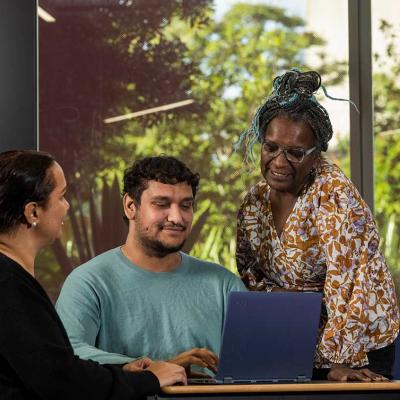
For Angus Loft, whose mob is Kamilaroi, the road to becoming a doctor hasn’t always been straightforward. But with an enduring curiosity as his driving force and a supportive community in the passenger seat, the destination is becoming clearer.

The proudest part of my journey so far is that I am where I am today, especially as an Aboriginal person. There have been several moments where I have doubted myself or struggled, so the fact that I have overcome these challenges is very rewarding for me.
When he first started at The University of Queensland (UQ), Angus went through phases of uncertainty and battled with imposter syndrome – feeling out of place and wondering if he was really capable of making it.
“Back when I was at that lowest point, I was questioning my place in medicine,” he says.
“My brain works differently to other people – they can generate answers quicker, where I need more of a moment. When that constantly happens, it can start to get to you, because if they know this, I should know it too.”
But courage isn’t the absence of fear; it’s how you handle it. And Angus did exactly that.
“You get to a point where you realise everyone is literally feeling the same thing,” he says.
“There are some things that I’m good at and they’re not, and vice versa. That realisation helped me overcome the uncertainty.
“Now, growing past that, I’m able to be more resilient. Even when I’m not as sure with my answers or thinking, I’m a lot more confident to make mistakes and seek help.”
“It’s definitely inspired me and made me stronger today, especially in my resolve. I don’t have that sense of doom like ‘I don’t know what I’m doing’ anymore.”
A story of support
It wasn’t bravery alone that pulled Angus through. He also credits the supportive nature of UQ’s medicine cohort for gradually turning his self-doubt into determination.
“Realising how long the journey would be at the start of med school terrified me a bit,” he admits.
“But I also quickly realised that I’m not alone in this situation – everyone else is there to offer support and looking for the same support.”
“I have a couple of different groups within med that have supported me. I’ve got a tight-knit group with other Indigenous med students, my placement group, and other people I’ve met along the way in hospitals and working groups. We don’t necessarily all share the same passions for what we want to do after medicine, but we share the same sense of community – we’ve gone through it all together.”
Having the right people in his corner at the right time has been a common thread in Angus’s journey, and this is something he is continuously grateful for. His cheerleaders include his parents, grandparents, three siblings, all his friends, and his partner, who is also studying medicine at UQ.
“Everyone has supported me in some way or form, whether it be by caring for me, providing financial support, offering emotional support, or just giving me encouragement in times when I needed it,” he says.
Even back in high school, when he first applied for provisional entry into the Doctor of Medicine, his family and community were immediately on board.
“My family is very close and always encourages me to pursue my passions… and this includes my studies in medicine,” says Angus.
At UQ, Angus found that support solidified even further, through initiatives such as the Indigenous Tutorial Assistance and Retention (ITAR) program, which offers one-on-one and small-group tutoring sessions.
“I’ve had three ITAR tutors over the course of medicine who are the only reason I am where I am today, especially with my knowledge,” he says.
“Also, my tutor for Clinical Coaching in second year played a huge part in my journey. She created a comfortable environment where we could make mistakes and be coached along the way… and that’s a big reason why I got over my fear of talking to people as patients.”

Angus’s path to medicine
Angus says there were several catalysts that guided him towards studying medicine rather than a single definitive event.
For example, he was an avid athlete as a teenager.
“I come from a very active family, which served as a role model for the importance of health and may have initially inspired me to pursue medicine,” says Angus.
“I did a lot of sports myself and was constantly injured when I was younger, so I had lots of interactions with healthcare professionals.”
Seeing firsthand the way these workers – especially physiotherapists and dietitians – support people with their health and recovery further awakened Angus’s passion for helping people and pushed him towards his undergraduate degree: the Bachelor of Exercise and Nutrition Science.
The final piece of the puzzle was attending a UQ InspireU health science camp during Year 11.
“InspireU was my first exposure to university and the medicine program,” says Angus.
“That camp gave me a glimpse at what students study in the realm of science here, and seeing that for the first time was really cool and eye-opening… it inspired me to look more into this as possibly something I’d be interested in doing.”
“I’d always had a bit of an interest in science but didn’t know exactly what intrigued me about it. InspireU showed me what a future in this area could look like and made me go ‘wow, my enjoyment of science can actually turn into something I want to do!’ It made me excited to finish high school and start uni.”
Angus also believes that Indigenous representation in medicine is crucial and is motivated to be part of improving this.
“I think it’s important for communities to have Indigenous doctors and healthcare professionals, as they offer a different perspective and lived experience,” he says.
“Socioeconomic status and psychological factors are prevalent issues that impact Indigenous communities, and having a doctor that understands this and can provide more patient-centred care is essential. This can benefit both Aboriginal and Torres Strait Islander peoples and non-Indigenous peoples alike.
“Indigenous doctors can also offer a different perspective from traditional medicine – like natural medicines and yarning techniques for medical assessments – which may improve patient care.”
Looking to the future
Angus is still debating the exact path he wants to take after graduating, but he hopes to pursue a career in psychiatry.
“I’ve been interested in mental health for a long time now, and psychiatry placements have confirmed that this is a space I’m interested in working in,” he says.
Completing a research project related to PTSD and attending a psychiatry conference in 2025 further assured Angus that this branch of medicine was a good fit for his interests.
“There's a huge excitement in finally narrowing down and getting to this point, especially realising that I've been shaped along the journey and finding purpose in why I'm doing this and where I want to go,” he says.
“I now know my purpose, the reason I chose to study medicine in the first place, is that I love helping people.”
“I just love what you’re able to do as a doctor and how you can help people – the fact that you can make a real difference in people’s lives.”
In the meantime, Angus is delighted if his story can help inspire any young Aboriginal and Torres Strait Islander people to follow a similar path.
“If you’re considering a career in medicine, do the research into what is required to enter, seek out opportunities like InspireU to gain some exposure to medicine, and just give it a go,” he says.
“Medicine has so many different avenues to pursue, and Aboriginal and Torres Strait Islander peoples belong in this space too. Our perspective is so important to the future of medicine, and you’ll be welcomed with open arms by fellow Indigenous medical students and doctors.”
Learn more about UQ's Doctor of Medicine Explore Aboriginal and Torres Strait Islanders pathways to the Doctor of Medicine
Article originally published in the Koori Mail Education Feature, September 2026