If you’d like to join an industry focused on the important goal of sustainably feeding an ever-growing global population, why not consider studying one of UQ’s agribusiness programs?
What can you do with an agribusiness degree from UQ?
With the world’s population set to reach 10 billion by 2050, there is growing global demand for experts who can supply us with sustainable, high-quality and affordable products.
With a career in agribusiness, you have the potential to shape the world’s future, both economically and environmentally – now is the perfect time to get serious about a career in this field.
What is agribusiness?
As a US$5 trillion industry, food and agribusiness plays a massive role in national and international economies. There are many ways to define agribusiness, but a simple way of looking at it is it covers everything from the production of food and fibre, through to its distribution and marketing.
In Australia, the sector is a major economic force. The gross value of the country's agriculture, fisheries and forestry production has grown by 45% over the past 20 years, reaching $100.3 billion in 2024–25, with around 71% of that production exported by volume.
Agribusiness is an interdisciplinary industry that places a strong focus on the commercial and business side of farming and agricultural efforts. Farmers, distributors, processors and consumers exist within a system that produces, processes, transports, markets and distributes agricultural products. That means studying agribusiness gives you far more than agricultural knowledge. You'll build commercial acumen, financial literacy, and an understanding of the global markets that connect producers to consumers.

Cultivate an agribusiness career in Australia
UQ is ranked #1 in Australia for agriculture and forestry (QS World University Rankings by Subject 2026), so studying agribusiness here will set you up with strong knowledge of the commercial side of agriculture and will teach you about the growing, processing, trading and financing of food and fibres. You’ll also gain valuable and transferable business skills, which can be applied across any industry, nationally and internationally.
What will you learn in an agribusiness program at UQ?
Combine technical and scientific knowledge of the agriculture industry with heightened commercial awareness and a market-oriented, global outlook in the field of agribusiness.
UQ’s agribusiness programs will prepare you by building your skills and confidence with courses focused on:
UQ’s agribusiness programs are taught at the specialist rural campus in Gatton, located roughly 1 hour west of Brisbane. Explore the Gatton campus online through a virtual tour. Home to over 1,000 hectares of farmlands, the campus has state-of-the-art research and teaching facilities, including:
- a dairy, and sheep and goat herds
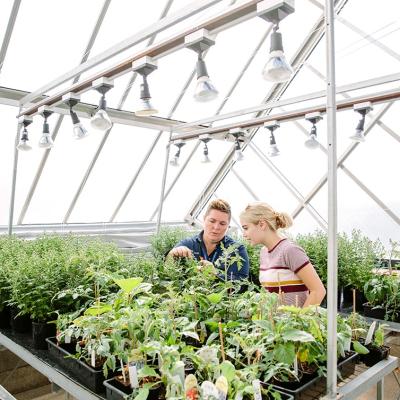
- research greenhouses and nurseries
- an extensive range of precision agriculture tools and farming technologies.

Study agribusiness at UQ and gain access to state-of-the-art agriculture facilities.
We’ve collected a couple of examples of the future-focused and world-changing research, development and consultative work being done by agribusiness graduates and researchers at UQ.
Protecting the world's banana supply
A UQ-led research team has made a major breakthrough in the fight against one of the biggest threats facing the global banana industry.
Fusarium wilt, also known as Panama disease, is a destructive soil-borne fungus that threatens Cavendish bananas worldwide. Once it takes hold in a field, it can persist in the soil for decades, leaving future crops vulnerable.
Dr Andrew Chen and Professor Elizabeth Aitken from UQ's School of Agriculture and Food Sustainability identified the precise genetic region in a wild banana subspecies that controls resistance to the disease. While the wild variety isn't edible, the discovery gives breeders a roadmap to develop commercial bananas that are naturally protected.
"Identifying and deploying natural resistance from wild bananas is a long-term and sustainable solution to this pathogen," Dr Chen said.
The 5-year project gives banana breeders the tools to screen seedlings early and accurately, speeding up the breeding process and reducing costs on the path to a disease-resistant commercial variety.

Weed-smart farming transforms livelihoods in Laos
When farmers in Laos switched from traditional rice transplanting to direct-seeded rice to save time and labour, they gained one problem for another: a surge in weed growth that was cutting yields and driving up costs.
Professor Jaquie Mitchell from UQ's School of Agriculture and Food Sustainability led a team that worked directly with Lao farmers to co-design practical solutions. Funded by the Australian Centre for International Agricultural Research (ACIAR), the project developed weed-smart farming packages that combined tailored planting and management techniques to keep weeds under control sustainably.
The results have been significant. Rice yields increased by around a third, and farm profits more than doubled compared with previous local practice, giving families greater financial security and more diverse income options.
"As well as the sustainable farming goals, the project has supported more flexible livelihood choices and more diverse household incomes," Professor Mitchell said.
In recognition of the project's impact, the UQ team received a Friendship Medal from the Lao People's Democratic Republic, one of the country's highest honours for international partners.
Agribusiness programs available at UQ
With growing demand for passionate agribusiness experts, now’s the time to join an industry at the forefront of ensuring food security for a growing population.
Start shaping your career in agribusiness at UQ by studying a: