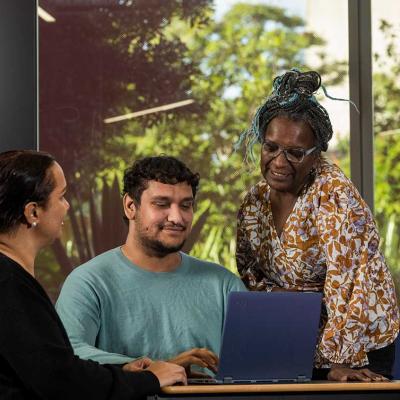
A conversation with Stephanie Gilbert (and that’s Professor Stephanie Gilbert to you, thank you very much) and Cassandra Diamond (Director of the Aboriginal and Torres Strait Islander Studies Unit at The University of Queensland). Originally published in the Koori Mail, April 2026.
Seeing Stephanie catch up with Cassandra over a coffee, you’d never guess they’ve only known each other for two years.
You might also wonder if they were a comedy duo in a former life. Every piece of advice Stephanie has for Cassandra, who is considering starting her own PhD, seems to come with a shared joke.
“How long does a PhD take anyway – three years?” asks Cassandra.
“It was eight for me,” says Stephanie.
“Eight!” Cassandra’s eyebrows shoot up.
“Oi, I was also writing a book, and I had four daughters at home at the same time,” Stephanie protests, pretending to be offended before breaking into a large grin.

Stephanie (right) is a Tubba-gah Wiradjuri and Kamilaroi woman, and Cassandra (left) is a Torres Strait Islander woman who grew up in Millmerran on the Darling Downs
Stephanie’s PhD on the Stolen Generation
When the laughter subsides, Stephanie begins talking about her own PhD research.
“I’m an interdisciplinary scholar – I think the nature of Aboriginal studies tends to do that,” she says.
Stephanie’s thesis topic, Women and Constructing Re-membering: Identity Formation in the Stolen Generations, combines her passion for history with her experience in Indigenous studies. It’s also partly informed by her professional background as a social worker, which included teaching in jails for five years.
Her research focused particularly on self-definition: how a person’s identity can be what they define it to be.
“Some people will have a particular experience and define themselves as not Aboriginal, whereas other people with the same experience could define themselves as Aboriginal,” she says.
“Many people speak about how they read their own body as indicators – the colour of their skin, the curliness of their hair, etcetera. I always think of this young man who lives in Townsville. He was very dark-skinned, and yet he had been adopted into a family and never identified as Aboriginal, didn’t see himself as that.”
“And so I went down the epigenetics path and even did a Fulbright scholarship to explore whether this is a phenomenon that appears in testimonies of people in New Zealand, Canada and the USA.”
Many PhD alumni will tell you their research was intense, absorptive, even gruelling. But for Stephanie, an even more potent word comes up: torturous. Because while many PhD candidates work with data, genetics, numbers and graphs, much of Stephanie’s research entailed reading stories from women who were forcibly taken from their homes as children – a deeply personal and emotional topic.
“I read more than a hundred Stolen Gen stories,” she says.
“And honestly, there were some days when the stuff I had written, read or was attempting to construct was so tortuous, that if I did five minutes, that was enough.”

From humble beginnings to academic acclaim
When Stephanie went straight from care into university at not-even-quite-18 years old, she had no idea it was her first step on the path to becoming a professor at The University of Queensland.
She didn’t have big plans or grand ambitions yet; she was a bit more concerned with stretching her $30 study allowance to cover her expenses, getting through her degree one class at a time.
“I wasn’t going ‘I’m going to be an academic and conquer the world!’, you know,” she says.
“I was flat-out, going ‘How do I even pass this stuff?’ and ‘What even is this?’”
Looking back now, having recently overcome the final hurdle in becoming a full-fledged professor, Stephanie hopes her achievements might make the road a little easier for the next generation of Indigenous scholars.
She feels a responsibility to be a visible representation and role model for younger people, proving that it’s possible for Indigenous people to become professors.
“I remember when I finished my PhD, and my nephews would go ‘Well, what do we call you now? Dr Auntie Steph? Auntie Dr Steph?’,” she smiles.
It’s obvious this is a passionate topic for Cassandra as well.
“I think we need to make a big deal out of things like Stephanie being made a professor,” she says.
“Because the landscapes of universities are changing. There are more of us – and more of us in a whole range of roles and positions. We’re student support workers and finance people, yes, but now we’re professors and deputy vice-chancellors too.”

For young people and students, it’s important for them to see that there are people like Stephanie who are here and thriving. And because of that work, this is going to be a better place for them.
Stephanie’s drive to make a positive, lasting impact comes partly from the Indigenous concept of seven – the idea that every person has the potential to influence seven generations (or even 12, in some cultures).
“It blows your mind to think, if I do something now, I’m already potentially influencing five generations, because I’ve got great-nieces and -nephews,” says Stephanie.
“But you can also count previous generations you’ve influenced. So there’s my own generation, I influence my mother, and my grandmother was alive until about 10 years ago too.”
And parsing through the past is standard practice for this self-described archivist. Stephanie’s personal research has helped her place her family in the Australian landscape:
- Her great-great-great-grandmother was a nanny for Banjo Patterson.
- Her great-grandfather, Arthur Clifford Burns, was involved in a variety of political struggles in NSW.
- Her mob are described as “the Blacks on the Mission” in William Ferguson’s autobiography.
Making higher education a more welcoming space
Along her academic journey across multiple institutions, Stephanie has encountered her fair share of racial insensitivities, as well as seeing how routinely male bias and homophobia occur. While things are improving over time, she’s excited to now be in a position where she can actively push for inclusive practices across higher education.
For example, making space for Acknowledgements of Country is essential, but it’s also important that presenters have the time and freedom to personalise these acknowledgements. Stephanie and Cassandra share a quiet chuckle about how many times they’ve been asked to deliver one with no notice.
“If I do the acknowledgement, I have to think about what I want to say in it,” explains Stephanie.
“So, for one day, it might be that I talk about my relationship with trees, because I want to get a point across about ethics. We know that trees feed each other, share nutrients, and acknowledge the presence of each other. They’re beings. So why do we worry about the ethics of humans and animals, but not about chopping down all the trees?"
“Another day, I might talk about Indigenous data sovereignty, like when a person interacts with the booth at a careers market. If you’re going to collect data, do it knowingly. What’s the purpose of this data and where is it going?”
Stephanie also believes obsessing over the ‘criteria’ of Aboriginality is a waste of time at best and problematic at worst.
“We shouldn’t be investing in deciding who’s in the category and who’s not,” she says.
“Because that actually is part of the colonising project – and if we do it, are we acting like colonisers too?”
What she does believe in, however, is making a concerted effort to get around to and engage with all the different pockets of Aboriginal people at universities, building real connections.
“It’s great for me, because otherwise I’m solo in my job,” she says.
“But it’s also good for them to have someone asking what they’re doing, because I’m genuinely interested, and the stuff they’re doing is amazing.”

I think it’s really important for people to do that sharing and caring and modelling and mentoring and, you know, just having ordinary, plain-old conversations.
Stephanie’s advice for PhD candidates and aspiring academics
“Run! Don’t do it!” jokes Stephanie.
After another round of hearty laughter, she offers these six pieces of advice:
1. Write. A lot.
“They reckon if you write every day for two hours, you’ll have written enough for the PhD. But it doesn’t have to be that strict – don’t get into a punishment regime. Just come to it every day in some way. And you have to be kind to yourself. Understand that there are moments where it’s hard and you haven’t quite got the right words or whatever. But that’s the point of writing regularly – even if it’s just a mind dump sometimes.”
2. Be flexible with your thesis.
“You have to allow a shift to happen. At the beginning, articulate as best you can what you think your question is and what you think you’re going to find. And then do the same at the end. Did those two come in close? I would’ve sworn that mine would be nothing alike, but they ended up exactly the same – I fell over with how much I was shocked by that. But that doesn’t always happen, and that’s fine.”
3. Attend workshops.
“As soon as I start feeling lost, I would attend workshops – even the same workshop. I did the workshop on how to write a literature review two or three times, just so I wasn’t alone. And I still have a Shut Up and Write group. We do two lots of 20 minutes, with a little bit of chat at the beginning, in the middle, and at the end of each 20 minutes. The point is that you’re giving and getting feedback, and dedicating those 20 minutes to writing.”
4. Create a contract with your supervisor.
“When you’re down the well doing your data collection, you won’t want to meet your supervisors every week – it might be monthly instead. That’s what the contract is about. It’s also about expectations: their expectations of you, and your expectations of them. For example, I knew I didn’t want to go to every function in the faculty to have different people asking me how I’m going over and over. So, I made that part of my contract.”
5. Understand your supervisor’s situation and hours.
“Get really clear about when they’re going to be available. Because it doesn’t matter if you’re a good student if you’re one of 15 (not that you should be one of 15 anyway). Also, work out how they allocate their time. Otherwise you’ll want two hours when they’ve only got 15 minutes.”
6. Don’t lose your spark. Keep your mind open to the possibilities.
“I think that sometimes we’ve forgotten how fun it can be to learn. Tap into that thing that you’re absolutely passionate about. You can’t imagine what your career is going to be, because you haven’t started that journey yet. Like, if someone had said to me back then that I was going to spend the rest of my life in academia, I would’ve told them to get stuffed!”

Ready to embark on your own research journey?
Learn more about UQ’s PhD program and start your application today.