

At UQ, we take research seriously. We’ve received more fellowships and awards from the Australian Research Council (ARC) than any other Australian university, and we’re proud to say that 100% of our research is at or above world standard.
Plus, with more than 100 research centres, it’s no wonder we’ve earned a global reputation for research excellence.
Read on to discover just some of the amazing breakthroughs made possible by UQ.

Saving lives through vaccine research
The 4th most common cancer for women around the world, cervical cancer, is responsible for hundreds of thousands of deaths every year.
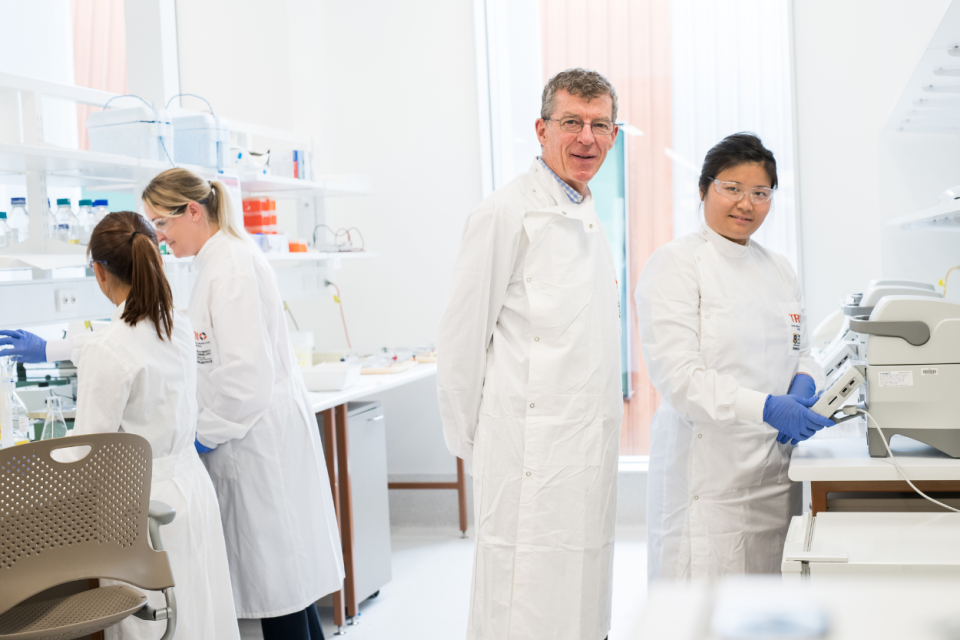
But this number is on the decline thanks to UQ’s scientists, including Professor Ian Frazer. This team developed a life-saving vaccine that significantly reduces the likelihood of recipients contracting human papillomavirus (HPV), a disease that causes almost every case of cervical cancer.
The vaccine was rolled out in Australia soon after, and by 2015, the rate of HPV infection among young women decreased dramatically from 22.7% to just 1.5%. Efforts are now on to ensure vaccines are available worldwide, which would effectively eradicate cervical cancer.
Protecting the planet from plastic waste
Since the 1950s, an estimated 8.3 billion metric tonnes of plastics have been produced, of which 6.3 billion tonnes have become waste. Worryingly, only 9% of this waste has been recycled, while 79% has accumulated in landfill or been released into the environment.
With predicted degradation times ranging from several centuries to a millennium, the quantity of environmental plastic continues to grow annually, with more than 460 million cubic tonnes of plastic waste produced each year, causing incredible damage to our environment and ecosystems.
But the days of single-use plastics may be numbered, thanks to a breakthrough by UQ scientists. Vincent Mathel and Dr Luigi Vandi at UQ’s School of Mechanical and Mining Engineering, within the Centre for Advanced Materials Processing and Manufacturing (AMPAM) have developed an innovative sustainable bioplastic composite, made entirely from biobased materials and including fibres derived from Australian residual organic waste, while offering the same properties as mass-produced plastics.
After being used, the bioplastic composite can be composted and, if it is lost in the environment, biodegrades entirely in fresh water, the ocean and soil.

Uncovering the mysteries of the brain
We might know a lot more about the brain than we used to, but much of how it works is still an enigma.
But now, thanks to Professor Frédéric Meunier and his team at the UQ Queensland Brain Institute, we know it much better – particularly an essential aspect of how memory is formed.
The researchers found that the brain uses myristic acid, a saturated fat, to essentially make memories ‘stick’. While more research is needed, understanding this process and pathway better could lead to future breakthroughs in learning and memory, as well as treatments for serious conditions like PTSD.

Creating a sustainable energy future
Solar energy is a renewable, clean source of energy that will play an important part in Australia’s sustainable future. However, there’s still a lot of work to do to develop and improve solar technology.
Thankfully, researchers at UQ’s Australian Institute for Bioengineering and Nanotechnology and the School of Chemical Engineering are on the case. A team led by Professor Lianzhou Wang has developed a solar cell that can create electricity from sunlight at a rate of 16.65%, almost a full percent higher than others.
Not only does this mark a huge leap in efficiency, but the THP cells developed by the team are made from sustainable materials and are more flexible and versatile than previous cells. Ultimately, this breakthrough could lead to widespread availability of better, eco-friendly and efficient solar power.

Improving our everyday technology
If you’ve ever dropped a phone, laptop, tablet or other device, you know the awful feeling of hearing the crunch of a shattering screen.
But that sensation could soon be a thing of the past, thanks to the work of a global research team led by UQ researchers. By wrapping delicate nanocrystals in porous glass, the team were able to create an innovative composite material that’s exceptionally strong while also providing excellent image quality.
This could mean better, stronger screens for everything from your TV to your smartphone, making tech more durable and longer-lasting for everyone.
Of course, this is just a small sample of the incredible research being done across UQ’s many institutions. You can find out more about our recent work at the UQ Research website.

Interested in studying in Australia? Let us introduce you to Brisbane.


