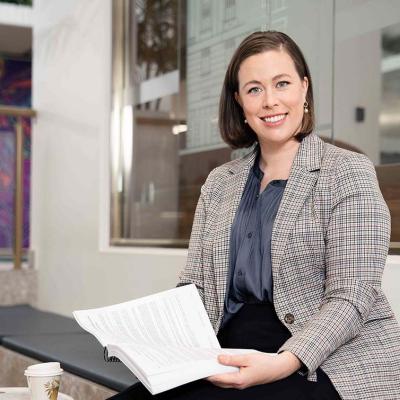
As a leader, instinct can only take you so far. The UQ-Oxford Executive Leadership Program helped Timothy Hortz turn instinct into a more intentional, repeatable and strategic leadership practice. Less than a month after completing the program, Timothy stepped into his most significant leadership role to date.
For Timothy Hortz, leadership has always come naturally.
Early in his public sector career, mentors recognised Timothy’s drive, organisation and initiative. As he moved into more senior management positions, however, he realised instinct could only take him so far.
While at the Department of State Development, Infrastructure and Planning, Timothy was encouraged to apply for the UQ-Oxford Executive Leadership Program. Timothy saw this as an opportunity to develop a more deliberate approach to his natural leadership style.
As a UQ alum, Timothy looks back fondly on his time at the University and, having already considered returning to further his professional development, he was eager for the opportunity to join the executive leadership program.
Within weeks of completing the program, he stepped into a new role as Executive Director of the Games Infrastructure (Venues and Villages) Division for the Queensland Government – arguably one of the state’s most critical infrastructure roles ahead of the Brisbane 2032 Olympic and Paralympic Games.
Here’s how Timothy’s experience in the UQ-Oxford Executive Leadership Program landed him his biggest career milestone yet.
Practical applications for practical solutions
Delivered over 6 months, the UQ-Oxford Executive Leadership Program brings together 8 workshops and peer coaching sessions at UQ’s heritage Brisbane City location, culminating in a 1-week residency at the University of Oxford Saïd Business School.
For Timothy, one of the program’s greatest strengths was its practical focus.
Rather than learning about leadership theory, participants used the lessons to tackle a real leadership challenge they were experiencing in their workplace.
At each stage, they tested their thinking, applied new approaches and socialised their findings with a cohort of peers, tackling similar problems.
“The world around us is changing faster than our methodologies, and these problems are adaptive – you can’t just apply one solution and expect that to get you through,” says Timothy.

After I came back from Oxford, I reached a point of resolution when facilitating a workshop and I managed to put everything I’d learned into practice. I had an increase in productivity, arriving at solutions far quicker than if I’d just done it the way I’d always done it.
As Timothy had often relied on his intuition in previous leadership roles, the experience was both validating and expansive.
“What I learned certainly supported some of my previous ways of working, but I also gained a whole new toolbox of tricks and processes," he says.
"I’m now far more purposeful and efficient in how I structure my programs and bring people together to find solutions."
“My new-found confidence to manage complexity, and my ability to articulate this, was probably the biggest capability I developed in the program.”
Learning from leadership experts alongside respected peers
While the program provided Timothy with new tools and frameworks, it was the fellow professionals around him who helped bring those learnings to life, challenging and supporting each other every step of the way.
One of his highlights was the integrated learning groups, which created a more intimate setting for focused peer-to-peer discussion and reflection, supervised by one of the program’s academics.
“It’s one thing to sit in a session, write your notes and complete the exercises, but it’s another to be held accountable by other colleagues in the program,” he says.
“At the root of it all, we’re all still learning, which can make you feel vulnerable. Being able to hold ourselves accountable in those smaller groups was so beneficial.”
The academics leading the program brought an added dimension to the experience, offering participants decades of expertise in leadership, strategy and organisational thinking.
For Timothy, this was no more evident than during the program’s 1-week immersion at the University of Oxford’s Saïd Business School.
“Oxford was certainly part of the program’s appeal, being built on decades of experience, prestige and capability,” he says.
"The academics there are advising the world’s top 1% on strategy and leadership, so you just listen and write notes as furiously as you can. I actually came back with a little black book packed with diagrams and scribbles that I still refer to weekly."
Turning 6 months of learning into action
Less than a month after returning from Oxford, Timothy landed his dream role.
In his new role as Executive Director of the Games Infrastructure (Venues and Villages) Division for the Queensland Government, he leads the planning and delivery of the Brisbane 2032 Olympic and Paralympic Games venues and athlete villages, coordinating across state, federal and local government.
It is a significant step up in responsibility from his previous role, but Timothy felt assured he could handle the challenge.
He quickly streamlined processes, developed systems to maintain efficiency while preventing burnout and, over the course of a few months, grew the team from 3 to 36 alongside a multitude of contractors.
“The program was an investment well made, because I settled into the role quickly," says Timothy.
"I pulled every trick out of my UQ-Oxford black book to get organised, delegate, maintain momentum and stay ahead of Games planning progress."
“I could not have stepped into the role with the same confidence had I not just completed the Executive Leadership Program.”
A personal journey as much as a professional one
More than 12 months after finishing the program, Timothy continues to draw on what he learned.
Importantly, the experience has changed the way he sees himself as a leader.
“We all experience imposter syndrome,” he says.
“Going through this learning process really validated that this role is for me and that I can do it. The program is amazing for executives like myself who are at the start of their leadership pathway.”
It’s a lesson he believes is relevant to anyone on their own professional development journey. And for aspiring leaders considering the program, his advice is simple: enrol.
“Even experienced leaders will find assumptions to challenge and learn new ways to approach complex problems.”
Interested in taking the next step in your leadership career? Learn more about the UQ-Oxford Executive Leadership Program.