

Help protect our natural world to enhance the quality of life for humans, animals and plants.
Insects have an enormous impact on the environment, human health and world economies. They play a significant role in spreading disease and reducing global food shortages, and are vital indicators of environmental change.
Examine how insects interact with and adapt to their surroundings, and understand their vital role within ecosystems.
You’ll combine theory and practice to explore topics relating to pest management, insect physiology, insect identification and taxonomy.
Learn from leading researchers who are actively involved with a wide variety of projects.
Apply your knowledge to tackle the impacts of climate change, inform conservation planning, or create eco-friendly pest management strategies to protect crops and livestock.
Career possibilities
Our programs prepare you for your first job and beyond. Here are some of the careers you could be on your way to:
- Ecologist
- Research scientist
- Biosecurity officer
- Principal environmental officer
- Agricultural scientist
- Policy and research officer
- Biodiversity specialist
- Environmental policy officer
Average annual salary range
Principal Biosecurity Officer
seek.com.au
Average annual salary range
Policy Adviser
seek.com.au
Next steps after graduation
Be part of the fastest growing occupational group in Australia: employment for life scientists with a Bachelor’s degree is predicted to grow by 20% by 2036.
When you graduate, you'll be in high demand by employers for your advanced technical, communication, independent thinking and problem-solving skills.
Expect to find employment in:
- agriculture and biosecurity
- environment and conservation
- public health and biomedical science
- urban development.

I was equipped with the most recent content knowledge by my world-class teachers, and the research experiences involved in my program enabled me to become a confident idea creator and synthesiser.
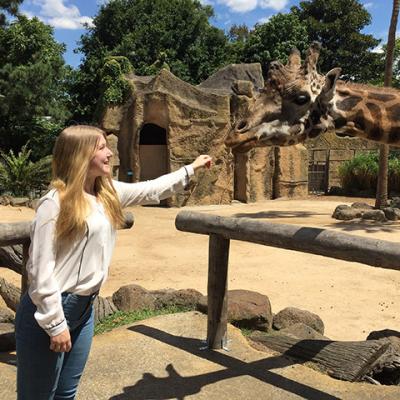
The advanced science program has helped me develop a well-rounded knowledge base in chemistry, mathematics and programming that I've been able to apply to a surprisingly large portion of my life – including a business I co-created at the end of my second year.
I was equipped with the most recent content knowledge by my world-class teachers, and the research experiences involved in my program enabled me to become a confident idea creator and synthesiser.
The advanced science program has helped me develop a well-rounded knowledge base in chemistry, mathematics and programming that I've been able to apply to a surprisingly large portion of my life – including a business I co-created at the end of my second year.
Events
See all events
29 October
Master of Mental Health information webinar

Stories
See all stories
Uni life
What's it really like to study science at UQ?
9-minute read

Study tips
UQ science scholarships to help fund your studies
8-minute read

Careers
What can you do with a Bachelor of Science?
7-minute read
Stories
See all storiesUni life
What's it really like to study science at UQ?
9-minute read
Study tips
UQ science scholarships to help fund your studies
8-minute read
Careers
What can you do with a Bachelor of Science?
7-minute read
How you'll learn
Your learning experiences are designed to best suit the learning outcomes of the courses you choose.
- Lectures
- Tutorials
- Laboratory work
What you'll study
At UQ, subjects are called 'courses'. Here's a sample of the courses you could study:
- Insect Science [Core course]
- Insect Structure, Function and Physiology [Elective]
- Arthropods & Human Health [Elective]
- Insect Identification & Taxonomy [Elective]
- Biodiversity & Systematics [Elective]
Helpful advice, right when you need it
Get useful info to help you navigate the confusing parts of getting into uni. Scholarship reminders, access to events and experiences, and advice from real students.
Sign up for updates. (No spam! We promise.)