


Doctor of Philosophy
Overview
A Doctor of Philosophy (PhD) is an internationally recognised graduate research program that will enable you to become an independent researcher.
With the guidance of an advisory team, you'll undertake a research project, produce an 80,000-word thesis and complete an oral examination.
A PhD takes 3 to 4 years full-time. Under guidance, you'll develop advanced research skills and knowledge in your chosen field.
The thesis is a substantial document that makes an original contribution to your field of research. Your thesis may involve an alternate format.
You'll need a strong academic background and you may need to submit a research proposal and other documents to support your application. About 1,000 PhD candidates join UQ each year researching a wide range of topics.
Research at UQ
UQ is one of Australia's top research-intensive universities. Our research makes an impact on the world's cultural, environmental, economic and social challenges.
Program highlights
- Be inspired and challenged to explore new ideas and develop greater understanding of complex questions with leading researchers.
- Access premier resources including one of Australia’s largest libraries, with more than 2 million physical resources and 116,800+ journal subscriptions.
- Foster and improve your skills through the Career Development Framework, created with industry.
- Learn from researchers whose work addresses national and global cultural, environmental, economic and social challenges.
Supervision
You have to find a thesis supervisor before you apply.
This supervisor will support, guide and mentor you through your research, and can introduce you to professional networks that will start your career.
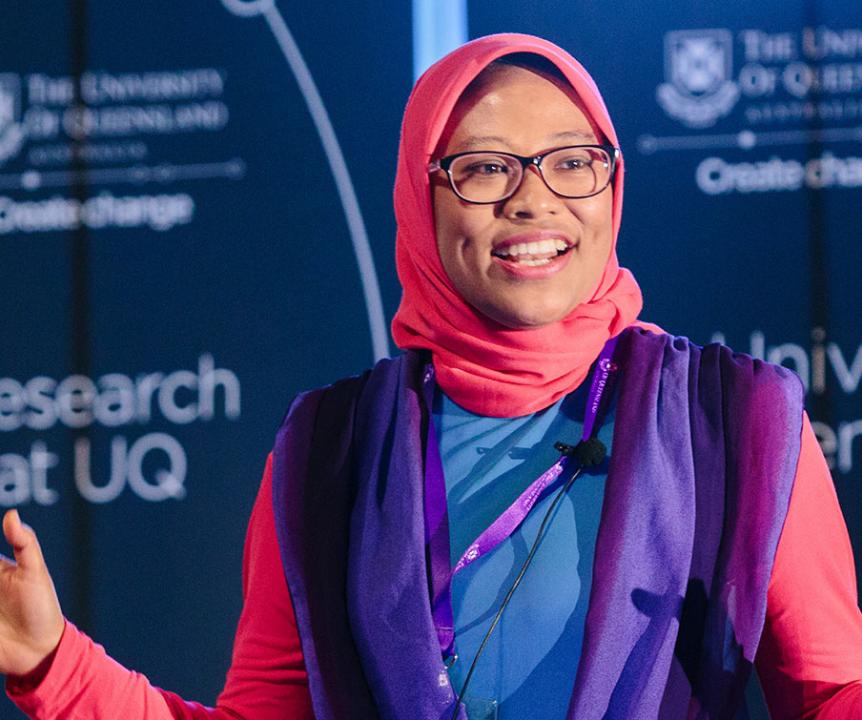
3-Minute Thesis
The showcase event for research candidates is the 3-Minute Thesis (3MT).
3MT is held each spring.
Career development
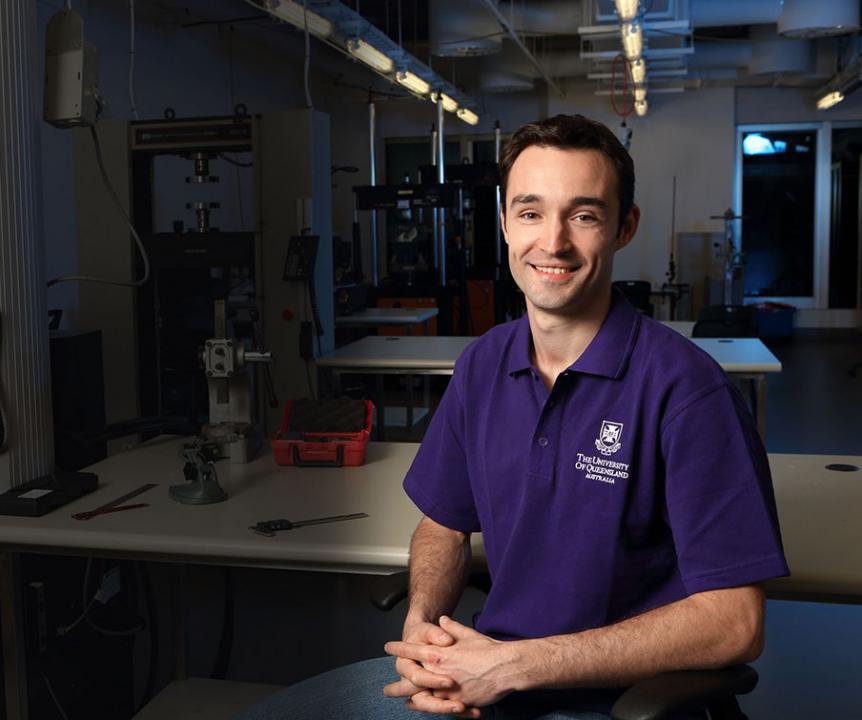
UQ offers a range of development opportunities via the Career Development Framework (CDF) to help you develop portable skills for any career or industry.

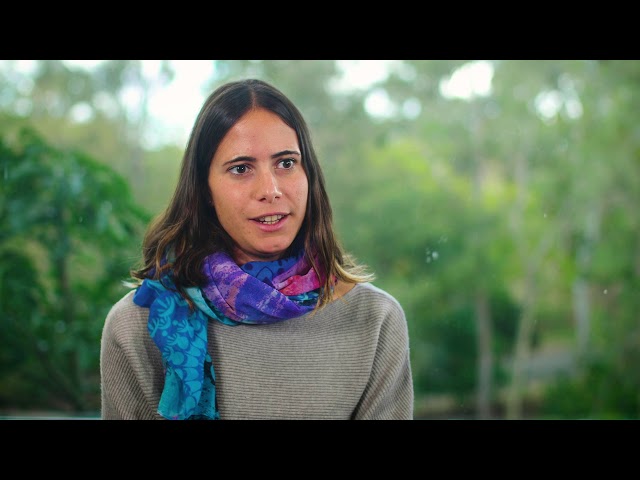
My research sits across various fields of study, and instead of having to choose between them, I’ve been encouraged to bring them together. UQ provided the space to explore questions that sit between disciplines, which was essential for the kind of research I wanted to do.

My supervisory team makes researching at UQ feel like being part of a community. My advisers have collaborated previously, so it really does feel like a team, and I feel extremely fortunate to have them.

Indigenous metaphysics and Indigenous language are the two main domains of my research. My multidisciplinary supervisory team cover these domains at depth, and together they helped me actualise a research project I can take pride in.

UQ gave me access to a truly multidisciplinary supervisory team – world-leading experts in neuroscience, health economics and neurology. This created the ideal environment to produce meaningful research that combines the strengths of these disciplines.

I’ve always been driven by curiosity and a love of learning. Being in a supportive environment where I could ask questions and be challenged helped me realise that research is a place where I can grow, contribute, and make a difference.
My research sits across various fields of study, and instead of having to choose between them, I’ve been encouraged to bring them together. UQ provided the space to explore questions that sit between disciplines, which was essential for the kind of research I wanted to do.
My supervisory team makes researching at UQ feel like being part of a community. My advisers have collaborated previously, so it really does feel like a team, and I feel extremely fortunate to have them.
Indigenous metaphysics and Indigenous language are the two main domains of my research. My multidisciplinary supervisory team cover these domains at depth, and together they helped me actualise a research project I can take pride in.
UQ gave me access to a truly multidisciplinary supervisory team – world-leading experts in neuroscience, health economics and neurology. This created the ideal environment to produce meaningful research that combines the strengths of these disciplines.
I’ve always been driven by curiosity and a love of learning. Being in a supportive environment where I could ask questions and be challenged helped me realise that research is a place where I can grow, contribute, and make a difference.
Events
See all events

29 October
Master of Mental Health information webinar

3 November
Postgraduate educational studies information webinar
Stories
See all stories


Stories
See all storiesEntry requirements
Academic entry requirements
You have to prove you are prepared for PhD study. You do this by showing you:
Approved degrees
An approved degree needs to be:
- in an area relevant to your proposed PhD project and
- completed no more than 10 years ago.
You need one of the following degrees to apply for a PhD. In each case, the degree must be approved by the Dean:
- Master of Philosophy (or another research master’s degree); or
- Bachelor’s degree from an approved university with at least honours class IIA or equivalent; or
- Coursework master’s degree with an overall grade point average of 5.65 on the 7-point UQ scale which includes relevant research experience
We'll consider the following degrees on a case-by-case basis, so long as you can demonstrate relevant research experience:
- Postgraduate degree (at least 1 year full-time or equivalent) with an overall grade point average of 5 on the 7-point UQ scale, together with demonstrated research experience equivalent to honours class IIA; or
- Bachelor’s degree without honours plus at least 2 years of relevant research experience
The ways you can demonstrate relevant research experience are listed below.
Relevant research experience
If you're applying with one of the below qualifications, you must demonstrate that you can plan and execute project work and/or a body of research with some independence.
- Bachelor's degree of at least 3 years without honours; or
- Coursework postgraduate qualification
You'll need to provide evidence of one of the following:
- A bachelor’s or coursework master’s degree that includes research training through research-focused courses and/or a supervised research project with a written report. The combined research component must be equivalent to at least 4 units at UQ, and at least 50% of the unit(s) must involve individually assessed, research-focused work. Research carried out in groups should have been graded individually.
- Scholarly papers involving a substantial contribution as an author, appearing in recognised academic journals or in volumes published by recognised academic publishers.
- Research or technical reports prepared for industry, government or business, which adhere to the broad conventions of academic publishing (i.e. contain an up-to-date review of relevant literature, a description of relevant research methods and an evaluation of results, etc.) and which identify you as a significant contributor.
- A portfolio of published creative work together with published critical discussion of some or all of that work, or of a comparable body of work by others, and which demonstrates your development of a scholarly approach to creative work as research investigation.
- Demonstrable industry or work experience where you can demonstrate that you have planned and executed a project, working with a high level of independence.
Student visas
International students who are accepted into full-time study in the Doctor of Philosophy are eligible to apply for an Australian Student visa (subclass 500).
This program has two CRICOS codes:
- 0100213 – Architecture, creative arts, education, health, information technology, management and commerce, mathematical sciences, social and cultural studies
- 0100214 – Agriculture and environmental studies, dentistry, engineering, human movement, medical studies, natural and physical sciences, pharmacy, psychology, veterinary science
Discuss your proposed project with us to determine which CRICOS code is most relevant for your visa application.
There are a number of requirements you must satisfy before a visa is granted, including the genuine temporary entrant (GTE) requirement.
Additional entry requirements
Many schools and institutes will have additional entry requirements and may request documents to support your application, such as a research proposal. If your nominated supervisor supports your expression of interest, you can discuss these additional requirements with them.
English language requirements
There are a few ways you can meet our English language requirements. If you sit a test, the following scores are needed for PhD admission:
| Test | Minimum overall score | Minimum additional scores |
|---|---|---|
| IELTS (clinical projects) | 7.0 | 7.0 in every sub-band |
| IELTS (all other disciplines) | 6.5 | 6.0 in every sub-band |
| TOEFL (paper-based) | 570 | 5.0 in TWE (written), and 54 in reading & listening |
Scholarships
There are several types of PhD scholarship:
- tuition fee scholarship: this covers the fees charged by UQ for PhD study
- living stipend scholarship: this is a fortnightly payment (or stipend) to support your daily expenses
- top-up scholarship: may be provided by external organisations, supervisors, or philanthropic donations. When awarded, they provide an additional payment on top of a living stipend scholarship. They cannot be held without a living stipend scholarship.
Each year, we award more than 600 scholarships to attract and support the highest quality higher degree by research applicants.
View all postgraduate research scholarships
University scholarships
Other scholarships
Throughout the year we advertise a range of other research scholarships, including top-up scholarships, travel grants and external scholarships, including:
How to apply for a scholarship
You can apply for many UQ scholarships when you apply for your PhD. External scholarships might have different ways to apply.
Our Scholarships website explains how to apply for each scholarship. If you are applying for a non-UQ scholarship, outcome dates may vary.
Fees and costs
Tuition fees
Your fees will vary according to your academic field, study load and whether you study internally or remotely.
Tuition fees
Your fees will vary according to your academic field, study load and whether you study internally or remotely.
Research costs
The department you enrol with will meet all necessary costs for your project, including:
- resource and facility costs: at UQ, which may include other organisations in Australia or overseas
- travel costs: to complete fieldwork, collect data, or to visit libraries or other repositories
- coursework costs: for courses studied outside the department
- relevant training: in particular methodologies or techniques.
How to apply
Before you apply
To apply, you will need to submit:
- an initial expression of interest (EOI), to ensure a supervisor will support your research
- a final application, if invited after the supervisor reviews your EOI.
1. Check your eligibility
Check your eligibility by reviewing the entry requirements for this program.
If you are applying for a scholarship or scholarship-funded project, check the eligibility and important dates for the scholarship or project.
2. Identify a potential supervisor or find a project
You'll either need to find:
- a supervisor in your field with expertise that's relevant to your proposed project. Find a supervisor
or
- a project you can join that suits your interests. See available projects.
3. Gather your documents
You will need to compile the necessary documents. We will accept scanned copies of original documents, but you will have to keep all original documents for the duration of your studies.
Upload all documents as PDFs and name your files like this: LASTNAME_firstname_document-name.pdf
If any of your documents is in a language other than English, you will need to provide both the original document and an official translation.
You must provide the following documents when you submit your expression of interest (EOI):
If your nominated supervisor supports your EOI, you will be invited to submit a final application. You must provide the following documents with your final application:
4. Submit an expression of interest
Once you have checked your eligibility, identified a potential supervisor or project, and prepared your documents, submit an expression of interest (EOI) online.
What happens next
The supervisor you've nominated will review your EOI. You should receive a response within 2 weeks. If you haven't heard from the supervisor after 4 weeks, you can contact us for advice.
If the supervisor is interested in working with you, they'll contact you to organise an informal interview. This is an opportunity for you and the supervisor to discuss your research interests in more detail and determine whether you're a good match.
If the supervisor supports your EOI, you will be invited to submit a final application.
Important dates
The deadlines to submit your EOI or final application will depend on whether you're applying for a UQ scholarship or project with a specific closing date.
Important dates
The deadlines to submit your EOI or final application will depend on whether you're applying for a UQ scholarship or project with a specific closing date.
Aboriginal and Torres Strait Islander applicants
For support with applying – or if you have any questions about university life – get in touch with our Aboriginal and Torres Strait Islander Studies (ATSIS) Unit.
Explore other programs
Helpful advice, right when you need it
Get useful info to help you navigate the confusing parts of getting into uni. Scholarship reminders, access to events and experiences, and advice from real students.
Sign up for updates. (No spam! We promise.)