

Develop the biological and computational expertise to use artificial intelligence, machine learning, statistics and bioinformatics to solve real biotechnology problems.
Modern biotechnology runs on data. From genomics and multi-omics to spatial biology, drug discovery and precision agriculture, new breakthroughs and jobs increasingly depend on people who can combine biological insight with advanced computational capability.
This field of study will teach you to frame important biological questions, select and apply appropriate statistical, bioinformatic and AI methods, and determine whether the results are robust and biologically meaningful.
You'll discover how to integrate complex biological datasets, build reproducible analytical workflows and use data and AI responsibly. Developed with industry employers, this field focuses on the computational and AI capabilities increasingly sought across modern-day jobs.
You'll combine advanced computational skills with a strong understanding of biological science, translation and commercial application.
Learn how to move from a biological problem to a defensible analysis, and from computational evidence to an experimentally testable hypothesis or biotechnology application.
You'll work with authentic data and translate computational findings into testable experiments, informed decisions and new biotechnology applications.
Taught by UQ researchers working across artificial intelligence, spatial omics, structural biology, population genomics and precision medicine, you'll graduate with experience that reflects how computational biotechnology is practised in research and industry.
Career possibilities
Postgraduate study can take you anywhere. Here are some of the careers you could be on your way to:
- Bioinformatician
- Master data analyst
- Biotechnologist
- Life scientist
- Genomics analyst
- Spatial data specialist
- AI product strategist
- Data scientist
- Research scientist
- Product development technologist
Average annual salary range
Data Scientist
seek.com.au
Average annual salary range
Research Analyst
seek.com.au
Next steps after graduation
Biotechnology organisations increasingly need people who understand biology, can work confidently with complex data, and can critically evaluate the results produced by computational and AI systems.
The capabilities developed through this field are relevant across biopharmaceutical research and development, drug discovery, genomics, diagnostics, precision medicine, agricultural biotechnology, research institutes, government and biotechnology consulting.
You'll graduate ready to help shape how data and AI are used to understand biology and develop the next generation of biotechnology.

The Master of Biotechnology is a blend of academic depth and industry relevance. The program strengthens technical capability through advanced coursework, but the real turning point for me was the semester-long industry placement. This experience transformed my classroom learning into tangible outcomes and showed me how biotechnology functions at industrial scale.

Now I can work towards addressing something really meaningful in the scientific community.

UQ offers so many opportunities to help students gain vital hands-on experience in their prospective industry outside of the classroom.
The Master of Biotechnology is a blend of academic depth and industry relevance. The program strengthens technical capability through advanced coursework, but the real turning point for me was the semester-long industry placement. This experience transformed my classroom learning into tangible outcomes and showed me how biotechnology functions at industrial scale.
Now I can work towards addressing something really meaningful in the scientific community.
UQ offers so many opportunities to help students gain vital hands-on experience in their prospective industry outside of the classroom.
Events
See all events
Stories
See all stories
Uni life
What’s it like to study biotechnology as a postgraduate?
7-minute read

UQ people
Science skills + business savvy = biotech success
4-minute read
Careers
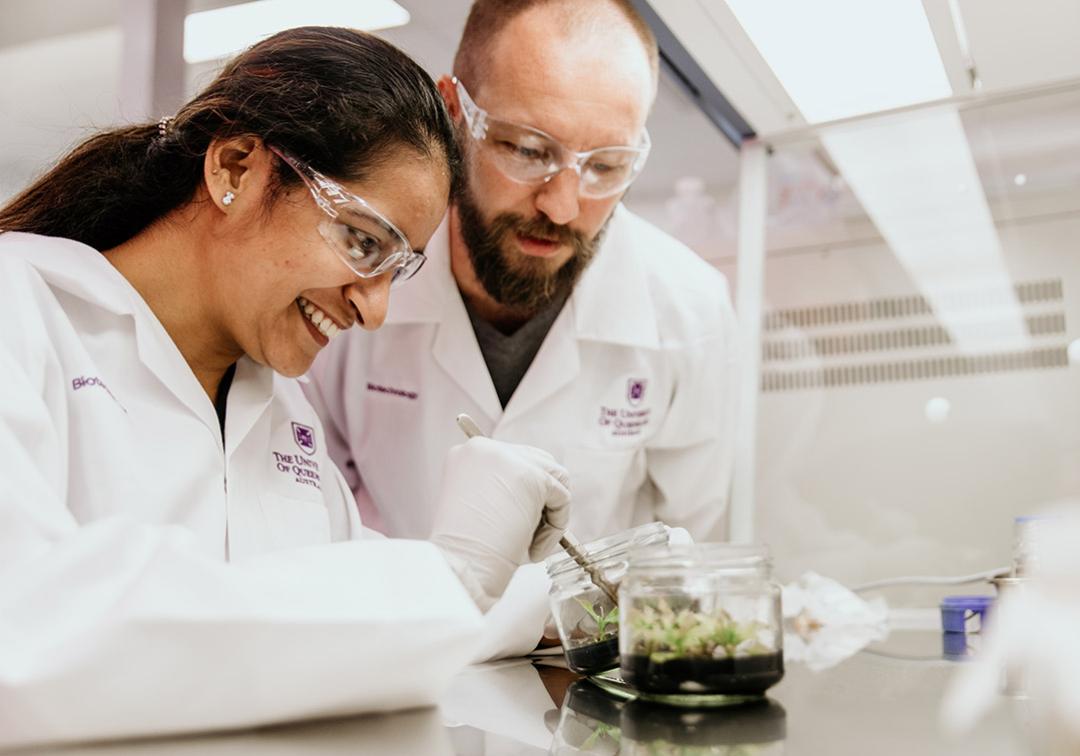
Study biotechnology at UQ to cultivate a cutting-edge career
5-minute read
Stories
See all storiesUni life
What’s it like to study biotechnology as a postgraduate?
7-minute read
Careers
Study biotechnology at UQ to cultivate a cutting-edge career
5-minute read
How you'll learn
Your learning experiences are designed to best suit the learning outcomes of the courses you choose.
- Lectures
- Tutorials
- Work placements
- Research experience
- Workshops
What you'll study
At UQ, subjects are called 'courses'. Here's a sample of the courses you could study:
- Frontiers in Computational Biotechnology [Core course]
- Biological Intelligence [Core course]
- Genomics and Bioinformatics [Elective]
- AI and Machine Learning [Elective]
- Statistics and Computing [Elective]
- Systems and Structural Biology [Elective]
Helpful advice, right when you need it
Get useful info to help you navigate the confusing parts of getting into uni. Scholarship reminders, access to events and experiences, and advice from real students.
Sign up for updates. (No spam! We promise.)