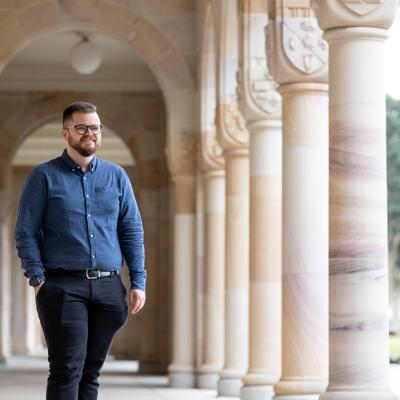
A Korean folk song, a forgotten war and a shared cultural heritage... this is what inspired the winning design of Super Studio 2026, Australia's largest design competition for architecture students.
Jaehong Kim and Seo Jin Hong's winning design, titled Arirang Gogae, is a memorial pavilion proposed for the Korean Demilitarized Zone (DMZ) and created to acknowledge the enduring impact of the Korean War.
The project was commended for its exploration of memory, loss and reconciliation, translating a nation’s collective story into an architectural experience that resonated with judges across the country.

A rendering of Arirang Gogae, with two people entering from different directions and meeting in the middle
Different paths, shared purpose
Although both students share Korean heritage, they arrived at architecture from different directions.
Jaehong came to UQ from South Korea, drawn by a long-standing interest in music, art and the work of renowned architects such as Tadao Ando. Visits to a Le Corbusier exhibition and Museum SAN sparked a fascination with architecture's ability to shape human experience.
"When it came time to choose a degree, there was nothing I wanted to study other than architecture," says Jaehong.
For Brisbane-born Seo Jin, architecture represented a balance between creativity and logic. While music had always been part of her life, she never saw herself as naturally artistic.
"I think I unconsciously wanted to learn something that was both creative and rational," she says.
"The word architecture just persistently came to mind."
The pair first worked together during 2025's Super Studio competition. Returning for a second attempt, they brought with them a clearer vision and a shared ambition to create architecture that people could genuinely connect with.
Looking beyond the brief
The competition theme in 2026 was Pause, Gather, Feel.
For Jaehong and Seo Jin, the brief raised a further question: what happens next?
As they explored the social pressures and divisions shaping contemporary life, their discussions turned to conflict. Eventually, they focused on a war that has largely faded from public discussion despite never officially ending: the Korean War.
Their research led them to Arrowhead Ridge within the DMZ, where South and North Korea collaborated to recover the remains of soldiers killed during the conflict.
The story left a lasting impression.
"The recovery of human remains is an act of quietly confronting the suffering of the past," they say.
From that idea, Arirang Gogae began to take shape.

Project overview from Jaehong and Seo Jin
Our project begins with the belief that the shared wounds of war can be remembered, and our shared identity reclaimed, through the one song both Koreas still possess together.
On Arrowhead Ridge, where the joint excavation took place, we propose a memorial pavilion. Where the architecture itself becomes a musical instrument. Visitors pluck strings integrated into the pavilion, allowing Arirang to resonate through the space.
At the entrance, they feel vibrations left by someone who has already passed through. Playing the melody, they arrive at a white stone ossuary and encounter another visitor approaching from the opposite direction.
Only after passing the centre do they realise that the vibrations they first experienced were created by someone entering from the other side – perhaps the north. Then another realisation follows: their own melody has also reached someone they will never know.
Together, they continue forward.
A memorial built around sound, memory and empathy
Taken from the lyrics of Korea’s best-known folk song, the project was designed as an emotional journey rather than a traditional monument.
The students wanted visitors to move through the pavilion guided by a sense of familiarity, hearing a song they recognised before arriving at an unexpected moment of reflection.
At its heart was a simple but powerful idea: that shared experiences can transcend division.
The design responds to the reality that many Koreans today live with the legacy of the peninsula's separation without consciously thinking about it, yet feelings of distrust and division can still surface unexpectedly.
Through architecture and sound, the pavilion invites visitors to put aside inherited assumptions and recognise a shared humanity. The experience encourages reflection on the millions of lives shaped by the same conflict and asks visitors to consider how prejudice and misunderstanding can be passed from one generation to the next.
Rather than focusing on politics, the project focuses on empathy.
A rewarding result
When the winning announcement came, the pair struggled to contain their excitement.
"We were jumping and screaming," they say.
"We kept saying thank you over the call, but our mic was muted."
The achievement held special significance after a year of growth, both individually and as collaborators. Reflecting on their first competition together, the students describe themselves as ambitious and passionate, but still developing a shared design language.
Over time, they learned how to combine their perspectives into a stronger and more focused vision.
"We realised that what we ultimately want is to create architecture that people can enjoy and appreciate."
For Jaehong, the win demonstrated that architecture can communicate cultural and historical stories beyond familiar audiences.
For Seo Jin, it reinforced her belief that art and architecture remain essential ways for people to connect with one another and understand the world around them.
Looking ahead
Both students say the experience has shaped how they see their futures as architects.
For Jaehong, the competition built confidence and highlighted the importance of creating architecture that is accessible to everyone, not just those within the profession.
"Most people who use a space are not familiar with an academic approach to architecture," he says.
For Seo Jin, the project strengthened her connection to Korean culture and reaffirmed the value of intimate storytelling in design.
"The most personal art is the best art," she says.
As they continue their architectural journeys, both hope to create work that communicates beyond the discipline itself, bringing people together through shared experiences and meaningful stories.
With Arirang Gogae, they have already shown just how powerful that approach can be.
Interested in studying architecture like Jaehong and Seo Jin?