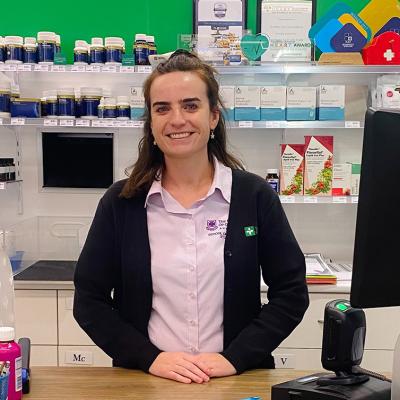
Are you curious about how medications work and want to make a meaningful difference in healthcare? If so, studying pharmacy at UQ might be the perfect pathway for you.
UQ is ranked #1 in Queensland and #22 in the world for pharmacy and pharmacology according to the QS World University Rankings 2026. But what makes us one of the best universities for pharmacy isn’t just our rankings. We offer a Bachelor of Pharmacy (Honours) that combines cutting-edge education with practical experience to prepare you for a wide range of exciting careers in healthcare.
Pharmacy graduate Isabella Bautista shares her top reasons why UQ is the best university to study pharmacy at and how a degree with us will set you up for success.
Prepare for a wide variety of careers
UQ Bachelor of Pharmacy (Honours) students graduate job-ready, with extensive practical experience and the opportunity to pursue a wide variety of careers.
“The most common pathways seem to be community or hospital pharmacy; however, you can also go into research, industrial practice, compounding, education, pharmacy business ownership, drug formulation, and many more,” says Isabella.
Graduate opportunities can also include employment as a pharmacist in general practice and residential aged care, or work in health policy and clinical trials management.
“Additionally, you can choose to do further study in fields such as medicine, where your existing pharmacy knowledge can help give you an edge.”
Isabella shares how the program equipped her with the knowledge, skills and confidence to graduate. She also highlights the value of strong peer connections in building a lasting support network beyond graduation.
“The final oral and written exams in fourth year mimic the internship examinations; these similar structures meant that I was already familiar with the expectations required for passing them.
"My connections with my peers also meant that I had a strong support system post-graduation to tackle my internship year”.
Isabella completed her internship at the Royal Brisbane and Women's Hospital in 2024 and is currently still working at RBWH completing her 2-year Residency training program.
“Pharmacists are always in demand, very highly trusted by the public as a profession, and there are many opportunities to branch out into different roles with this profession.
"With increased public interest and strong potential for a larger scope of practice, there is no better time than now to explore what pharmacy can offer”.
Alongside her residency, Isabella also creates content relevant to the pharmacy industry.
“During my time at university, my involvement as part of the Executive committee for the Queensland Pharmacy Students’ Association allowed me to meet with various stakeholders and business owners in the industry.
"I was lucky enough to start working for one of these companies as part of their marketing team, creating content for people in every stage of their pharmacy career.”
Learn more about the many avenues a career in pharmacy can take you down.

Exciting and diverse placements
One of the biggest benefits of studying pharmacy at UQ is the opportunity to complete over 350 hours of supervised clinical practice across a range of dynamic healthcare settings.
Isabella gained valuable hands-on experience from day one, progressing to two 4-week block placements in her final year (pharmacy students will attend two 6-week block placements from 2025).
“Doing patient case studies during my hospital placements was an incredible way to apply the clinical knowledge we learned in class and see firsthand how pharmacists contribute to the healthcare team.”
These placements also open doors for future employment, with UQ’s School of Pharmacy and Pharmaceutical Sciences partnering with over 500 pharmacies across rural and metropolitan Australia, as well as internationally.
“My final hospital placement included both a research project and supervised clinical practice with a dedicated preceptor," says Isabella.
"These experiences allowed me to give first-hand examples of my clinical knowledge, communication skills, and industry involvement when I was applying for competitive internship positions both in Queensland and interstate.”
Discover the benefits of undertaking a rural placement during your studies.
Gain essential skills for your career
Isabella highlights that UQ’s Bachelor of Pharmacy (Honours) has significantly enhanced her appreciation for teamwork and collaboration.
“Healthcare is inherently a collaborative field, requiring robust communication skills across different disciplines to ensure optimal patient-centred care,” she says.
“UQ’s interdisciplinary courses focus on developing these skills, which I hadn't fully explored before.”
As a pharmacy student, you’ll practice your communication skills in a hands-on way that allows for helpful and constructive feedback.
“Skills such as empathy and active listening, honed through roleplays and oral assessments in class, are invaluable both within and beyond the profession.”
“Mastering effective and respectful communication is key to building meaningful connections with anyone you encounter,” Isabella says.
Learn in state-of-the-art facilities
Classes take place in state-of-the-art laboratories and simulated pharmacies at UQ’s Dutton Park campus, which includes a $100m purpose-built pharmacy facility located next door to the Princess Alexandra Hospital.

The mock dispensaries, dispensing rooms, and compounding labs give us the opportunity to experience what it’s like to practise in community pharmacy and be immersed in the profession.
Isabella emphasises that the facilities are also designed to help students feel welcome and build connections.
“A sense of community is also fostered within our learning environment in the School of Pharmacy and Pharmaceutical Sciences,” she says.
“The shared spaces in the library, cafe, and student spaces mean that we can hang out with friends from different cohorts and grab food between classes.”
Prepare for postgraduate study
If you’re interested in progressing to postgraduate studies, the Bachelor of Pharmacy (Honours) is an excellent foundation for undertaking UQ’s Master of Clinical Pharmacy or the Master of Pharmaceutical Industry Practice.
The Master of Clinical Pharmacy will prepare you for advanced clinical practice and leadership roles in clinical pharmacy, while the Master of Pharmaceutical Industry Practice provides the skills and experiences for a wide range of roles within the pharmaceutical industry. You could find yourself working in areas such as regulatory affairs and clinical research management.
Many students use their undergraduate degree to springboard into a completely different field of study.
Explore UQ’s Bachelor of Pharmacy (Honours) to discover more reasons it should be your first QTAC preference.