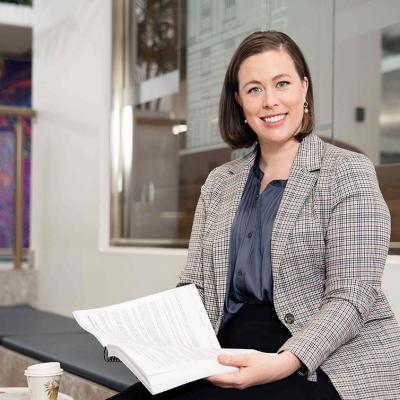
When mining engineer Scott Barker discovered vast amounts of methane were being vented and flared from Queensland coal mines, he saw an opportunity to turn a major emissions challenge into a business opportunity.
Today, as co-founder of Carbon Logica, he has helped deploy more than $150 million into methane abatement projects across Australia's resource sector. He credits UQ’s Master of Business Administration (MBA) with giving him the strategic, financial and leadership skills needed to scale the business.
Working as an operational leader with a background as a mining engineer, Scott Barker had spent most of his career mitigating the challenges posed by methane emissions in coal mines. His friend and mechanical engineer Mark Jonker had recently visited the USA and Europe to learn how these markets converted agricultural waste feedstocks into a fossil fuel replacement.
As Scott listened to Mark talk about project costs and gas volumes, he couldn’t help but compare his insights to what he’d seen working in underground coal mining.
“While his agricultural decarbonisation passion was real, I thought he was missing the low hanging methane abatement opportunity right in front of us in the resources industry, so I took him to visit a mine in the Bowen Basin,” says Scott.
During their tour underground, they arrived at a gas drainage site. Mark asked a simple question: what happened to the methane after it was captured from the mine?
“I knew the gas was being drained to the surface, but that was about the extent of my knowledge... so we went back to the surface to find out what happened to it,” Scott says.
It turned out the site was releasing 400 litres of methane-rich gas into the atmosphere every second, an emissions impact comparable to around 60,000 passenger vehicles.
“Mark, who was spending time and money chasing small volumes of agricultural gas, was shocked. He looked at me and said, 'This is the problem we should be solving.' I didn’t know this back then, but that one bore hole had enough energy in the waste gas to fuel a 5MW power station – more than enough energy to run the whole mine.”
Two years later, they had co-founded Carbon Logica and commissioned their first waste coal mine gas-to-electricity project. By accelerating methane drainage, producing electricity and utilising highly efficient flaring technology, the business reduces fugitive greenhouse emissions. Since they started, they’ve committed over $150 million into the sector, with a pipeline of projects planned over the next few years.

Scott and his Carbon Logica team
Why a mining engineer chose the UQ MBA
In his role as a mining engineer, Scott found he was increasingly working across financial modelling, accounting and business scenario planning. To better contribute to strategic decision-making, he realised he needed to upskill. After considering different ways to build his finance and accounting skills, he realised what he needed was a broader business perspective to fill his knowledge gaps.

It wasn’t just the things I knew I needed to learn; it was the things I didn’t even know I didn’t know. This realisation prompted me to go straight into the MBA rather than starting with the graduate certificate.
“My wife, Helen, had completed the UQ MBA years earlier," says Scott.
"I saw first-hand how it expanded her network and continued to create opportunities long after she graduated. I was also keen to study in person, and with the UQ Brisbane City location right across the road from where I was working, it just made sense.”
Turning classroom learning into sustainable business results
Because Scott was in the process of building the Carbon Logica start-up, he says every assignment became an opportunity to apply theory straight into the business.
“Rather than working on hypothetical cases, I used our own business challenges as the basis for essays, group projects and presentations. This meant that feedback from professors and peers on assessment not only improved my grades but also sharpened our business pitch and plans.”
Working in a highly practical industry, Scott enjoyed learning from the industry experts, who made the content engaging and immediately applicable. “Their teaching style helped bridge the gap between academic insights and the challenges I was navigating in real life,” he says.
All UQ MBA students complete at least one Impact Academy course during their program, giving them the entrepreneurial tools and frameworks to address complex, ‘wicked’ problems.
Rather than focus on his own business, Scott took this opportunity to work on a different but complementary project collaborating with energy‐sector colleagues.
“Over 5 months, I worked with peers from the electricity industry to develop a go-to-market strategy for a subsidiary of a large generator – one that would offer operations and maintenance services to renewable energy projects.
“By focusing on this renewable operations and management venture, I not only learned best practices in service‐based models and regulatory considerations; I built a network far broader than my original mining contacts," he says.
"Those connections, including senior engineers and project leads in wind, solar and hydro, continue to be valuable contacts for Carbon Logica.”

Scott is a Queensland Mines Rescue Member, pictured here with Carbon Logica team member Rebekah
3 ways the UQ MBA accelerated Scott's business growth
1. Enhanced business capabilities, enhanced credibility and trust
Because Scott had only worked as an engineer in large organisations across the resource industry before starting the MBA, he’d assumed all businesses operate the same way. The MBA allowed him to explore how a much wider range of businesses operate.
“What I learned shifted my perspective from a technically focused mining engineer to a strategic thinker and leader equipped with frameworks I could apply immediately to make better decisions in my own business," he says.
“The structured knowledge I gained in finance, strategy and innovation was invaluable as we refined our business model, evaluated investment opportunities, and raised capital to fund our growth.”
Studying while simultaneously building a business from scratch allowed Scott to test classroom concepts in a real business environment.
“I also found earning the UQ MBA alongside my engineering credentials elevated my credibility and built trust with the board, investors and partners,” he says.
2. Building capacity for bigger challenges
Scott juggled part-time study with a full-time role, a young family and the launch of a new business. He says mastering this juggle honed his leadership, prioritisation and communication skills in high-pressure scenarios.
“The UQ MBA is designed to be flexible, and that was critical for me,” he says.
“I mixed weeknight classes, weekend sessions, and intensives to fit around work and family commitments. Family support was essential. Because Helen, my wife, had completed the MBA before me, she knew exactly what I was facing and was a huge support throughout.”

Scott with Helen and their 2 children at Scott's graduation
3. New connections and new opportunities
Scott says the way the MBA expanded his network was just as important as the skills he gained.
“As my career had been relatively siloed, studying alongside professionals from different industries was a key benefit of the MBA. I still meet up with the group I studied with once a quarter to learn about the relevant issues and success of each of our respective industries.”
Through various student, alumni and industry awards, the UQ MBA ecosystem also led to new opportunities for exposure. Scott says these opportunities helped raise his profile, opening doors and accelerating conversations that mattered in the early stages of Carbon Logica’s growth.
“There’s no doubt that the MBA helped accelerate the build out of Carbon Logica, which is now helping to reduce emissions across the resource sector in Queensland,” he says.
Discover what’s possible with a UQ MBA.