

Bachelors of Science / Education (Secondary)
Overview
Turn your passion for science into a rewarding career in secondary education.
This 4-year dual degree equips you with deep scientific knowledge and the skills to inspire the next generation.
You'll gain expertise in 2 teaching areas through the Bachelor of Science, while the Bachelor of Education (Secondary) provides the professional training, hands-on experience, and qualifications needed for teacher registration.
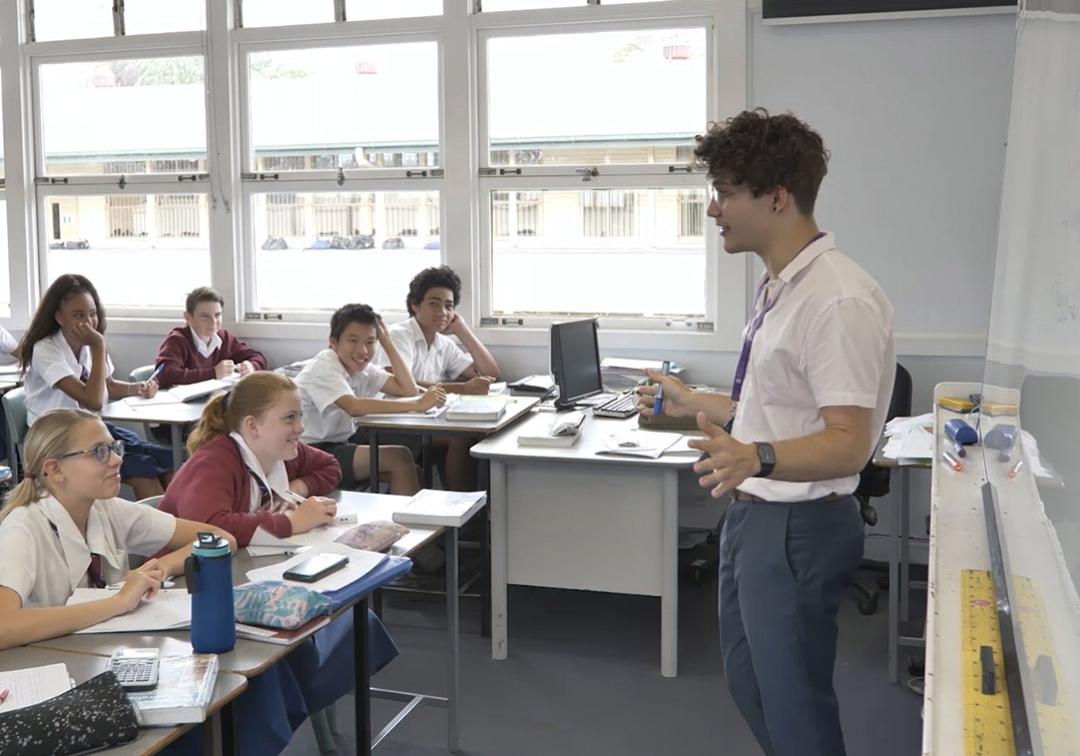
With school-based learning and research-backed teaching methods, you'll graduate ready for the classroom—or for roles in business and industry training.
The science component offers one of Australia’s broadest selections of disciplines, allowing you to tailor your studies to your interests while building interdisciplinary expertise and practical skills.
Program highlights
- Earn 2 degrees and expertise in multiple science teaching areas.
- Gain classroom experience, with placements available from early in your degree.
- Graduate with high-level teaching ability and a wide range of scientific skills, ready to excel in a challenging and rewarding profession.

Majors
Tailor your studies to suit your goals. This program offers these options:
- Applied Mathematics
- Applied Mathematics
- Astrophysics
- Biochemistry and Molecular Biology
How you'll learn
Your learning experiences are designed to best suit the learning outcomes of the courses you choose.
- Lectures
- Tutorials
- Work placements
- Laboratory work
- Fieldwork
- Workshops
Placements and work experience
You¿ll undertake 80 days of supervised and assessed professional experience throughout the Bachelors of Science/Education (Secondary).
Every effort is made to place you within a reasonable distance of your home base, but you can be expected to travel up to 90 minutes due to public transport connections and incur costs associated with travel and possible lost income over this period.
You can expect to be placed at Ipswich, Brisbane, and southeast Queensland (including the Gold Coast and Sunshine Coast) and are encouraged to explore the option of a rural placement. Financial assistance may be available to assist with travel and accommodation costs for rural placements.
You are required to have a current Blue Card (Working with Children Check) before commencing practicum. The Professional Experience Handbook provides information about practicum and school experience requirements and is available from School of Education. Please visit the School of Education website to access required resources.
What you'll study
At UQ, degrees are called 'programs' and subjects are called 'courses'.
Career possibilities
Our programs prepare you for your first job and beyond. Depending on which major you choose, here are some of the careers you could be on your way to:
- Secondary school teacher
- School laboratory technician
- School curriculum adviser
- Head of curriculum
- Science technician
- Middle school teacher
Average annual salary range
Science Teacher
seek.com.au
Average annual salary range
Laboratory Supervisor
seek.com.au
Next steps after graduation
You'll be eligible to apply for registration as a teacher with the Queensland College of Teachers, and to work as a school teacher in state and independent schools in Australia and worldwide.
Further study and experience can lead to roles as a head of department, principal, guidance officer, learning support teacher or student adviser.
Other graduates choose to work with non-school-based education providers (such as tutoring companies), government agencies or education advocacy organisations.
Professional memberships
When you graduate, you may be eligible for memberships with the following professional organisations. Contact the organisation to find out how to become a member.
- Queensland College of Teachers
Professional registration
When you graduate, you may be eligible for registration with the following professional organisations. Contact the organisation to find out how to register.
- Queensland College Of Teachers
Program accreditation
The Bachelors of Science / Education (Secondary) is accredited by:
- Australian Institute For Teaching And School Leadership

Thanks to UQ’s program and supportive staff, I felt unbelievably prepared and excited to start teaching and helping students learn about science and themselves.
Thanks to UQ’s program and supportive staff, I felt unbelievably prepared and excited to start teaching and helping students learn about science and themselves.
Events
See all events
29 October
Master of Mental Health information webinar

3 November
Postgraduate educational studies information webinar

Stories
See all stories

Uni life
What's it really like to study science at UQ?
9-minute read
Stories
See all storiesUni life
What's it really like to study science at UQ?
9-minute read

Entry requirements
Prerequisites
- General English subject (Units 3 & 4, C)
- Mathematical Methods (Units 3 & 4, C), and
- one of Biology, Chemistry, Earth and Environmental Science, or Physics (Units 3 & 4, C).
- From Semester 1, 2028, Earth and Environmental Science will no longer be accepted.
Prerequisites
- General English subject (Units 3 & 4, C)
- Mathematical Methods (Units 3 & 4, C), and
- one of Biology, Chemistry, Earth and Environmental Science, or Physics (Units 3 & 4, C).
- From Semester 1, 2028, Earth and Environmental Science will no longer be accepted.
Entry score threshold
| ATAR / Rank | IB |
|---|---|
| 80 | 30.25 |
These are the lowest adjusted scores we made an offer to in Semester 1, 2026. Entry scores are based on the most recent Semester 1 intake and are updated in April each year. Meeting the entry score threshold doesn't guarantee admission.
English language requirements
IELTS score of 7.5 overall; speaking 8; listening 8, reading 7, writing 7. For other English Language Proficiency Tests and Scores approved for UQ.
TOEFL iBT (Paper Edition), PTE Academic, BE, CES, and OET are not accepted.
There are other ways to meet the English language requirements. For some programs, additional conditions apply.
Inherent requirements
To complete this degree, you have to meet its inherent requirements by demonstrating essential skills and attributes. Read the inherent requirements before you apply.
Student visas
International students who are accepted into full-time study in the Bachelors of Science / Education (Secondary) are eligible to apply for an Australian student visa (subclass 500).
There are a number of requirements you must satisfy before a visa is granted, including the Genuine Student (GS) requirement.
Entry score range
This table shows the range of entry scores for recent secondary students offered a place in the B Science/BEduc(Secondary) for Semester 1, 2026
| Without adjustments | With adjustments | |
|---|---|---|
| Highest | 97.05 | 99.95 |
| Median | 92.15 | 94.25 |
| Lowest | 76.6 | 80.6 |
Who you'll study with
Here's a snapshot of our student intake for this program in Semester 1, 2026:
| Applicant background | Number of students | Percentage of all students |
|---|---|---|
(A) Higher education study | <5 | <5 |
(B) Vocational Education and Training (VET) study | <5 | <5 |
(C) Work and life experience | 0 | 0% |
| (D) Recent secondary education | ||
| 22 | 78.6% |
| 0 | 0% |
| 0 | 0% |
International students | <5 | <5 |
Total | 28 | 100% |
"<5" — The number of students is less than 5.
N/A — Students not accepted in this category.
N/P — Not published. The number is hidden to protect the privacy of students in other cells.
Need help meeting the entry requirements?
Majors and minors
Majors
Tailor your studies to suit your goals. This program offers these options:
Minors
Tailor your studies to suit your goals. This program offers these options:
Majors
Tailor your studies to suit your goals. This program offers these options:
Minors
Tailor your studies to suit your goals. This program offers these options:
Fees and Scholarships
Indicative annual fee
Approximate yearly cost of tuition (16 units). Your fees will vary according to your selected courses and study load. Fees are reviewed each year and may increase.
$7,155
2027
Approximate yearly cost of tuition (16 units). Your fees will vary according to your study load. Fees are reviewed each year and may increase.
AUD $56,800
2027
Additional costs
- Students are expected to fund travel and living expenses associated with placements, some of which may be outside the Brisbane metropolitan area.
- You are required to meet the Literacy and Numeracy Test for Initial Teacher Education (LANTITE) standards to graduate. Visit teacheredtest.acer.edu.au/register/payment for current test fees.
Government assistance
Financial aid
As an international student, you might be eligible for financial aid – either from your home country, or from the Australian Government.
HECS-HELP
Domestic places in the Bachelors of Science / Education (Secondary) are Commonwealth supported, as long as you meet all Commonwealth supported place eligibility requirements.
This means the cost of your education is shared between you and the Australian Government. Instead of tuition fees, Commonwealth supported students pay what are called student contribution amounts.
If you have a Commonwealth supported place, you may also be eligible for HECS-HELP. This is an Australian Government loan scheme to assist eligible students with the cost of their student contribution amounts.
Centrelink support
The Australian Government offers a number of income-support payments to eligible Australian university students.
Scholarships
You may be eligible for more than 100 scholarships, including:
How to apply
Applying online
If your senior schooling is from outside Australia, you can submit your application to UQ. Or, if you prefer, you can use an approved UQ agent near you.
The program code for the Bachelors of Science / Education (Secondary) is 2479.
How to apply for undergraduate study
If your senior schooling is from Australia
Submit your application to the Queensland Tertiary Admissions Centre if you're an international student who is currently studying:
- Australian Year 12 (in Australia or another country), or
- the International Baccalaureate in Australia.
The QTAC code for the Bachelors of Science / Education (Secondary) is 731302.
Applying through QTAC
All domestic applications should be submitted to the Queensland Tertiary Admissions Centre (QTAC).
The QTAC code for the Bachelors of Science / Education (Secondary) is 731302.
Important dates
If you’re studying Year 12 in Australia, go to the QTAC website to check the closing date for this program.
If you’re applying to UQ, the closing date for this program is:
- To commence study in semester 1 - November 30 of the previous year.
Visa processing times vary. Apply and accept your offer as early as you can.
To learn more about UQ dates, including semester start dates, view the Academic Calendar.
Important dates
To check the closing date for this program, go to the QTAC website.
To learn more about UQ dates, including semester start dates, view the Academic Calendar.
Admissions schemes
Applying to university can be both exciting and daunting, which is why we’ve tried to make the process as simple as we can.
We have several schemes in place to improve your chances of getting a place at UQ.
Pathway options
A rank or score doesn’t determine your potential.
If you're not offered a place in your first-choice program – or if you don't meet the entry requirements – you still have a number of options.
Aboriginal and Torres Strait Islander applicants
For support with applying – or if you have any questions about university life – get in touch with our Aboriginal and Torres Strait Islander Studies (ATSIS) Unit.
Explore other programs
Helpful advice, right when you need it
Get useful info to help you navigate the confusing parts of getting into uni. Scholarship reminders, access to events and experiences, and advice from real students.
Sign up for updates. (No spam! We promise.)