

Deepen your understanding of the universe and our place in it.
Led by internationally recognised researchers, you’ll explore theories behind the creation of the universe to understand the origin and evolution of galaxies, stars and planets.
Examine the theories and fundamental laws behind how matter and radiation are created, how galaxies and planetary systems form, and how environments for life develop.
Study the physical processes behind the structure of the Milky Way, star formation, stellar atmospheres, black holes, gravitational waves and the cosmic microwave background.
Learn to build computer simulations of the universe to investigate some of the big questions in modern astrophysics and cosmology, including:
- What are dark energy and dark matter?
- How did the universe begin and how will it end?
- Where did the contents of the universe come from?
- How and when do galaxies form?
You’ll have access to state-of-the-art computing facilities, as well as specialised tools and instruments used in astrophysics research.
Combine a minor in astrophysics with a major in physics to prepare for a career in research or other scientific fields. You’ll be well placed to continue into a research-based honours degree.
Career possibilities
Our programs prepare you for your first job and beyond. Here are some of the careers you could be on your way to:
- Aerospace engineer
- Data scientist
- Research scientist
- Research engineer
- Technology analyst
- Aerospace scientist
- Energy project manager
- University researcher
Average annual salary range
Laboratory Supervisor
seek.com.au
Average annual salary range
Systems Analyst
seek.com.au
Next steps after graduation
Qualified astrophysicists can find a range of employment opportunities due to their problem solving, computational and analytical skills.
Demand is also increasing due to the Australian Civil Space Strategy 2019-2028, which is creating 20,000 space industry roles by 2030.

My degree offers 26 different majors, giving me the wonderful gift of flexibility to explore the different flavours of science. I've been able to change my major without losing any time, credits or experiences.
My degree offers 26 different majors, giving me the wonderful gift of flexibility to explore the different flavours of science. I've been able to change my major without losing any time, credits or experiences.
Events
See all events
29 October
Master of Mental Health information webinar

Stories
See all stories
Uni life
What's it really like to study science at UQ?
9-minute read

Study tips
UQ science scholarships to help fund your studies
8-minute read
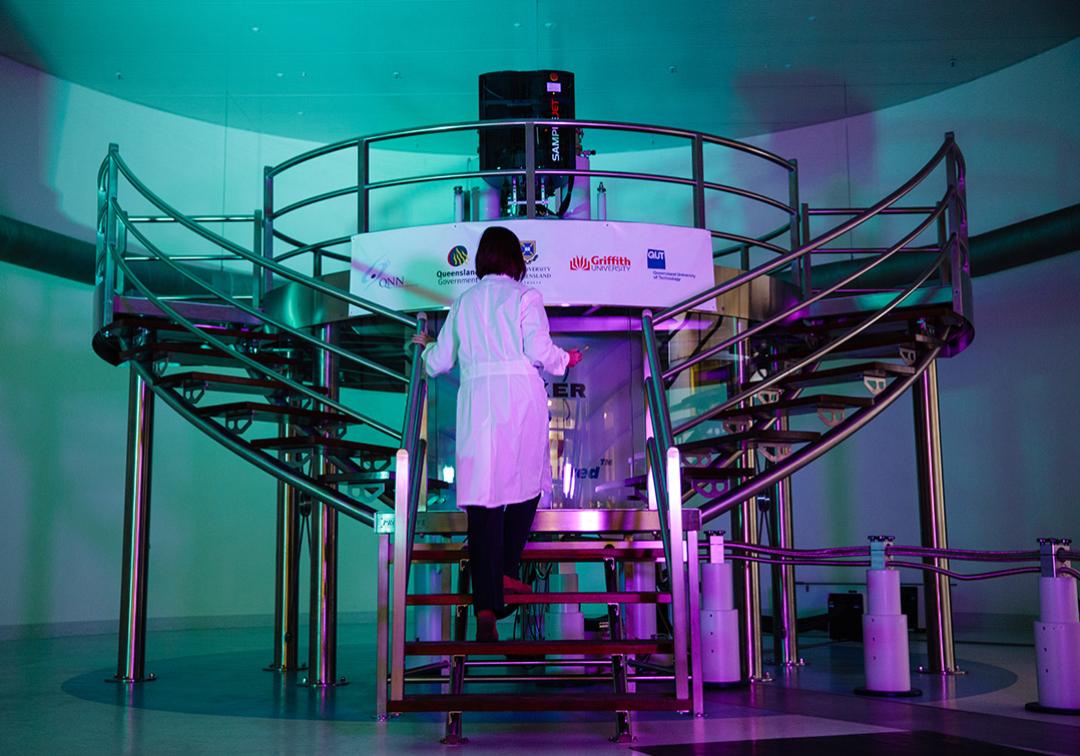
UQ people
Careers in science: Ruth Mirams' journey
3-minute read
Stories
See all storiesUni life
What's it really like to study science at UQ?
9-minute read
Study tips
UQ science scholarships to help fund your studies
8-minute read

How you'll learn
Your learning experiences are designed to best suit the learning outcomes of the courses you choose.
- Lectures
- Tutorials
- Research experience
- Laboratory work
- Fieldwork
- Workshops
What you'll study
At UQ, subjects are called 'courses'. Here's a sample of the courses you could study:
- Space Science & Stellar Astrophysics
- Extragalactic Astrophysics & Cosmology
- Electromagnetism & Modern Physics
- Mechanics & Thermal Physics
Helpful advice, right when you need it
Get useful info to help you navigate the confusing parts of getting into uni. Scholarship reminders, access to events and experiences, and advice from real students.
Sign up for updates. (No spam! We promise.)